


Market Summary
According to latest research by Growth Market Reports, the global Gallium Nitride (GaN) Epiwafers for Power Electronics market size reached USD 2.21 billion in 2025, reflecting robust demand driven by advances in power electronics and the accelerating shift toward energy-efficient semiconductor solutions. The market is currently expanding at a CAGR of 18.5% and is forecasted to attain USD 10.47 billion by 2034. This impressive growth trajectory is primarily fueled by the accelerating adoption of GaN-based devices in automotive, consumer electronics, and telecommunications sectors, where the need for high-performance, compact, and energy-efficient power solutions is paramount.
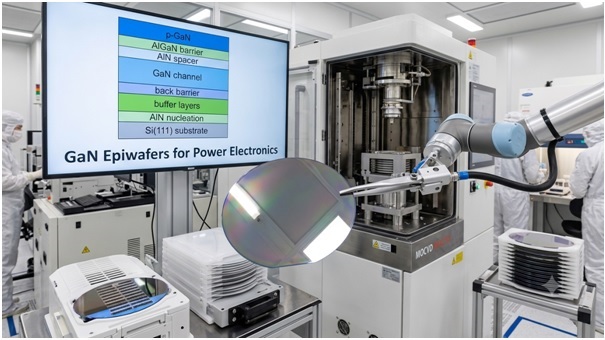
The Galli Nitride (GaN) Epiwafers for Power Electronics Market umis entering a high-growth phase as industries seek semiconductor materials capable of delivering greater efficiency, faster switching, and higher power density. GaNepiwafers serve as a critical foundation for manufacturing advanced power devices. Their material characteristics support high-frequency operation and efficient power conversion, helping manufacturers develop smaller and more capable electronic systems. Growing interest in electrification, energy efficiency, and compact power architectures is strengthening demand across multiple industries.
Key Drivers
Rising Demand for Energy-Efficient Power Electronics
Energy efficiency has become a major priority for electronics manufacturers, data centers, automotive companies, and industrial equipment developers. GaN technology offers advantages in high-frequency switching and power conversion, making it attractive for applications where reducing energy losses and improving power density are important.
The transition toward more efficient power architectures is encouraging greater investment in GaN device development. Research organizations are also exploring improved device structures, substrates, epitaxial growth methods, and system-level designs to expand the technology’s performance envelope.
Electric Vehicles and Charging Infrastructure
The expansion of electric mobility is creating new opportunities for GaNepiwafer manufacturers. Electric vehicles require efficient power conversion across charging systems, DC-DC converters, auxiliary power systems, and other electronic components.
Although silicon and silicon carbide remain important semiconductor technologies, GaN is gaining attention for applications where high switching frequency, compact dimensions, and efficiency are particularly valuable. Continued improvements in GaN device reliability could further support its adoption in next-generation automotive power electronics.
Advances in Wafer Manufacturing
Manufacturing technology remains central to the development of the GaNepiwafer industry. Suppliers are working to improve epitaxial layer uniformity, reduce defects, enhance material quality, and increase wafer diameter. Larger wafers can potentially improve manufacturing economics by supporting greater device output per substrate.
Recent developments in GaN production include efforts to scale six-inch materials and refine epitaxial growth processes for mass production. Such advances could help reduce production costs while improving consistency and device performance.
Data Centers Create New Growth Opportunities
The rapid expansion of artificial intelligence and cloud computing is increasing demand for efficient power delivery within data centers. High-performance computing infrastructure requires power conversion systems that can handle increasing electrical loads while controlling energy consumption and thermal requirements.
Recent research highlights GaN’s potential in selected stages of data-center power conversion, particularly applications requiring high-frequency operation and efficient low-to-mid-voltage conversion. This creates an emerging opportunity for epiwafer suppliers capable of meeting demanding quality and reliability requirements.
Challenges Facing the Market
Despite strong growth prospects, the industry faces several challenges. GaNepiwafer production requires sophisticated equipment, precise epitaxial processes, and stringent quality control. Defect management and substrate selection can significantly influence device performance and manufacturing yields.
Cost competitiveness is another important consideration. As manufacturers compare GaN with established silicon technologies and other wide-bandgap materials, suppliers must demonstrate clear performance and economic benefits. Developing scalable production processes will therefore remain essential for wider adoption.
Competitive Landscape
IQE plc
Sumitomo Electric Industries, Ltd.
Wolfspeed, Inc.
Enkris Semiconductor Inc.
EpiGaN (Soitec)
SCIOCS Co., Ltd.
MACOM Technology Solutions (NITRONEX)
Veeco Instruments Inc.
Aixtron SE
Qorvo, Inc.
Future Outlook
The future of the Gallium Nitride Epiwafers Market will be shaped by the convergence of electrification, artificial intelligence infrastructure, renewable energy, advanced consumer electronics, and high-efficiency power conversion. As manufacturers continue improving substrate technologies and epitaxial processes, GaN could become increasingly important in compact and energy-conscious power systems.
With its strong projected growth and expanding application base, the market represents a significant opportunity within the advanced semiconductor materials industry. Continued innovation in wafer manufacturing, device architecture, reliability, and cost optimization will determine how quickly GaN moves into broader power electronics applications.