


Market Summary
According to latest research by Growth Market Reports, the global On-Chip Micro Supercapacitor market size reached USD 1.78 billion in 2025, demonstrating robust growth driven by rapid advancements in miniaturized energy storage technologies. The market is projected to expand at a CAGR of 22.7% from 2026 to 2034, reaching an estimated USD 12.8 billion by 2034. This remarkable growth trajectory is fueled by increasing demand for compact, high-performance energy storage solutions in applications such as consumer electronics, IoT devices, and wearable technology, as manufacturers seek to enhance device efficiency and longevity without compromising form factor.
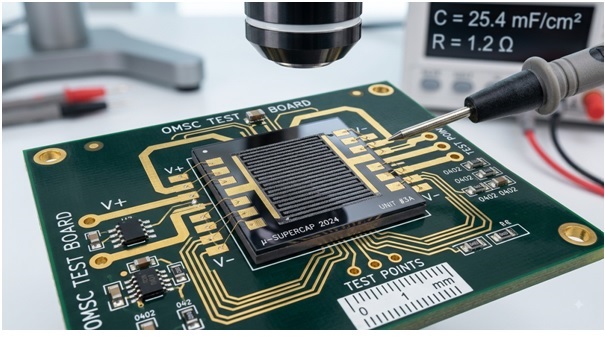
The On-Chip Micro Supercapacitor Market is gaining momentum as electronics manufacturers seek compact energy-storage solutions capable of delivering rapid power while occupying minimal space. Micro-supercapacitors are designed for direct integration with electronic circuits, sensors, and semiconductor platforms, making them increasingly relevant to highly miniaturized and connected devices. Research highlights their fast charge-discharge capability, high power density, and long operating life compared with many conventional micro-energy-storage technologies.
Key Drivers
Growing Demand for Miniaturized Energy Storage
The continued miniaturization of electronic components is creating a need for energy-storage devices that can operate within extremely limited footprints. Conventional batteries may provide greater overall energy storage, but micro-supercapacitors offer advantages where rapid energy delivery, frequent cycling, and compact integration are priorities.
On-chip configurations can support applications requiring short bursts of power and stable energy delivery. Their ability to function as localized energy buffers is particularly relevant for sensors, wireless devices, MEMS, and autonomous electronics.
Advanced Materials Transforming the Market
Material innovation remains a central area of development. Researchers are exploring carbon-based electrodes, graphene, carbon nanotubes, transition-metal compounds, conducting polymers, MXenes, and hybrid structures to improve electrochemical performance.
Three-dimensional electrode architectures are also attracting attention because they can increase active material utilization without substantially expanding the device footprint. Recent research indicates that 3D nanostructuring can improve ion transport and increase areal energy-storage capabilities, addressing an important limitation of conventional planar micro-supercapacitors.
Challenges
The On-Chip Micro Supercapacitor Market faces challenges related to limited energy density, complex fabrication processes, and difficulties in achieving high performance within extremely small device footprints. Unlike conventional batteries, micro-supercapacitors generally store less energy, which can restrict their use in applications requiring sustained power. Manufacturing consistency, electrode integration, electrolyte compatibility, thermal stability, and reliable packaging also remain important concerns, particularly for semiconductor-scale production.
Another challenge is the cost and complexity of integrating advanced materials and micro-supercapacitors with existing chip manufacturing processes. Materials such as graphene, MXenes, and other nanostructured electrodes can improve performance but may introduce scalability and processing difficulties. Establishing standardized manufacturing methods, improving long-term reliability, and achieving cost-effective mass production will be essential for wider commercial adoption across IoT, wearable electronics, sensors, and advanced computing applications.
Opportunities
The On-Chip Micro Supercapacitor Market presents significant opportunities as demand grows for compact, high-performance energy-storage solutions across IoT devices, wearable electronics, smart sensors, MEMS, edge computing, and advanced semiconductor systems.
Integration with energy-harvesting technologies such as solar, thermal, and vibration-based systems could enable self-powered electronics, while advances in graphene, MXenes, carbon nanotubes, conducting polymers, and 3D electrode architectures may improve energy density and power performance. The increasing adoption of flexible and miniaturized electronics also creates opportunities for manufacturers to develop lightweight, flexible, and semiconductor-compatible micro-supercapacitors for next-generation applications.
Competitive Landscape
Murata Manufacturing Co., Ltd.
Maxwell Technologies (Tesla, Inc.)
Skeleton Technologies
Cap-XX Limited
VARTA AG
Panasonic Corporation
Kyocera Corporation
Nippon Chemi-Con Corporation
AVX Corporation (KYOCERA AVX)
Samwha Capacitor Group
Future Outlook
The future of the On-Chip Micro Supercapacitor Market will depend on the ability to combine higher energy density with fast power delivery, long cycle life, scalable manufacturing, and semiconductor-compatible integration. As electronics become smaller, smarter, and more autonomous, localized energy storage is expected to become increasingly valuable.
With continued advances in electrode materials, 3D architectures, solid-state electrolytes, and fabrication technologies, on-chip micro-supercapacitors could become an important component of next-generation IoT, wearable, AI, MEMS, and edge-computing systems.
Source: https://growthmarketreports.com/report/on-chip-micro-supercapacitor-market