


The energy-storage conversation is changing. As solar and wind capacity expands, the challenge is no longer simply generating clean electricity—it is storing that electricity long enough to make the grid more flexible, reliable, and economically efficient.
This is creating a strategic opening for flow batteries. Unlike conventional batteries that store energy within solid electrodes, flow batteries use liquid electrolytes held in external tanks, allowing power and energy capacity to be configured more independently. That architecture makes the technology particularly relevant for applications requiring extended-duration storage.
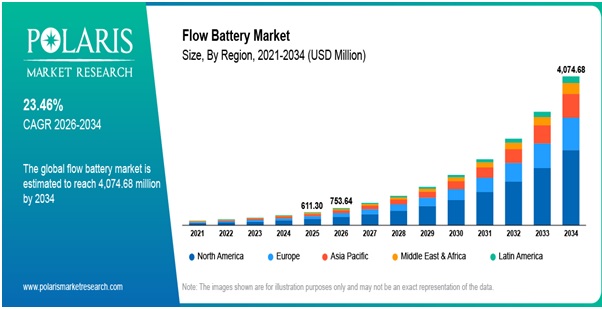
According to Polaris Market Research, the global Flow Battery Market was valued at USD 611.30 million in 2025 and is projected to reach USD 4,074.68 Billionby 2034, expanding at a 23.46% CAGR from 2026 to 2034.
The bigger business story, however, is not simply the market’s growth rate. It is the changing economics and infrastructure requirements of an electricity system increasingly dependent on variable renewable generation.
Why Renewable Energy Is Creating a Long-Duration Storage Problem
Renewable power creates a fundamental timing challenge. Solar generation can peak when electricity demand does not, while wind output can fluctuate independently of consumption.
For utilities and renewable developers, this means adding generation capacity alone is insufficient. They also need technologies capable of shifting electricity from periods of surplus production to periods of higher demand.
Flow batteries are well positioned for this role because their energy capacity can be expanded by increasing electrolyte volume and tank size. This creates a potentially attractive model for grid-scale and long-duration energy storage, where operating duration and lifecycle performance can matter as much as upfront power capacity.
Polaris identifies renewable-energy integration as a major market driver and notes that grid storage accounted for 52.3% of the market in 2025.
The Business Implication
For energy companies, the opportunity is moving beyond battery manufacturing. The emerging value chain includes energy-management software, electrolyte technologies, system integration, monitoring, grid services, and project development.
That creates opportunities for electronics and semiconductor companies as well. Advanced sensors, power electronics, control systems, monitoring platforms, and AI-enabled analytics can become critical components of increasingly sophisticated storage infrastructure.
Flow Batteries Are Becoming a Grid Infrastructure Decision
The strongest near-term opportunity lies in applications where long-duration storage can solve an operational problem.
Utilities are already looking at storage as an essential component of grid modernization rather than simply backup capacity. Flow batteries can help absorb renewable-energy surpluses, provide electricity during periods of high demand, and support microgrids and other distributed-energy applications.
The Polaris report identifies utilities as the leading end-user segment in 2025, while grid storage remains the dominant application.
This matters strategically because storage projects are increasingly evaluated according to their ability to deliver value over years—not merely their initial purchase price.
The challenge is that flow battery systems can require substantial upfront investment and specialized infrastructure. Electrolyte systems, storage tanks, equipment, installation, and project integration can make deployment more complex than conventional battery solutions.
For buyers, therefore, the critical question is shifting from “What is the cheapest battery?” to “Which storage architecture delivers the best lifetime value for this application?”
For more information, visit @ https://www.polarismarketresearch.com/industry-analysis/flow-battery-market
Regional Markets Are Following Different Energy Strategies
Asia Pacific: The Current Market Leader
Asia Pacific accounted for 41.8% of the global flow battery market in 2025, making it the largest regional market. Rapid renewable-energy deployment, energy-storage investment, and government-backed clean-energy programs are supporting demand across China, Japan, India, and Australia.
North America: The Growth Opportunity
North America is projected to be the fastest-growing regional market through 2034. Renewable-energy expansion, grid investment, and demand for reliable long-duration storage are creating an attractive environment for new projects.
Europe: Storage as a Renewable-Enabler
Europe’s energy transition is also strengthening the case for long-duration storage. Renewable-energy targets, grid flexibility requirements, and growing EV infrastructure are increasing the need for technologies that can stabilize electricity supply over longer periods.
Competition Is Shifting Toward Technology and Project Execution
The competitive landscape includes Invinity Energy Systems, ESS Tech, Sumitomo Electric Industries, CellCube Energy Storage, Largo, VRB Energy, Elestor, Jena Flow Batteries, Stryten Energy, Quino Energy, StorEn Technologies, and Redox One, among others.
Competition is increasingly centered on more than battery chemistry. Companies are differentiating through system durability, scalability, electrolyte performance, digital monitoring, modular architectures, and project execution.
Innovation is also extending into AI-enabled monitoring and digital twins, which can help operators improve uptime, optimize performance, and reduce operational risk.
What Comes Next for the Flow Battery Market?
The next phase of growth will likely depend on whether manufacturers can overcome the industry’s biggest commercial barriers: high initial costs, infrastructure complexity, supply-chain constraints, and competition from alternative storage technologies.
At the same time, several trends are strengthening the opportunity. Renewable capacity continues to expand, EV charging infrastructure is growing, and utilities are investing in grid modernization. The Polaris report also identifies sodium-based flow batteries as a fast-growing chemistry as the industry explores more diversified approaches to long-duration storage.
For business leaders, this suggests a broader strategic shift: flow batteries should not be viewed simply as another battery category. They are part of a developing energy-infrastructure ecosystem connecting renewable generation, grid management, power electronics, software, and long-duration storage.
Conclusion: The Competitive Advantage May Be Duration
The future of energy storage will not be determined by a single battery technology. Different applications will require different combinations of power, duration, cost, safety, scalability, and lifecycle performance.
Flow batteries have a compelling role to play where long-duration storage and grid flexibility are the priorities. With the global market projected to grow from USD 611.30 million in 2025 to USD 4.07 billion by 2034, the commercial opportunity is expanding rapidly.
For companies across electronics, energy, and infrastructure, the strategic question is increasingly clear: Who will build the technologies and business models that turn long-duration storage into a competitive advantage for the renewable-powered grid?
Read More @ https://www.polarismarketresearch.com