



Market Summary
According to our Growth Market Report, the global electric vehicle (EV) battery market size reached USD 89.7 billion in 2025, reflecting robust expansion driven by surging electric vehicle adoption worldwide. The market is projected to grow at a remarkable CAGR of 19.1% from 2026 to 2034, reaching an anticipated value of USD 432.5 billion by 2034. This impressive growth is primarily fueled by increasing government incentives, rapid technological advances in battery chemistry, and intensifying consumer demand for sustainable transportation. The EV battery market stands at the forefront of the global transition towards clean mobility, with strong momentum expected to continue throughout the forecast period.
Introduction
The Electric Vehicle Battery Market has become one of the most influential sectors shaping the future of transportation, clean energy, and industrial innovation. While electric vehicles (EVs) often capture headlines for their sleek designs and environmental benefits, the battery remains the true engine of transformation. It determines vehicle range, charging speed, safety, performance, and long-term ownership costs. As governments strengthen carbon reduction commitments and consumers increasingly embrace electric mobility, battery technology has evolved from a supporting component into a strategic asset that influences global supply chains, technological leadership, and energy security.
Modern battery manufacturing is no longer limited to automotive applications. It intersects with renewable energy storage, artificial intelligence-driven manufacturing, recycling technologies, and critical mineral development. This interconnected ecosystem is creating new business opportunities while encouraging countries to invest in domestic battery production capabilities.
What Is the Electric Vehicle Battery Market?
The Electric Vehicle Battery Market encompasses the research, development, manufacturing, distribution, and recycling of rechargeable batteries designed specifically for electric vehicles. These batteries supply the electrical energy required to power electric motors and onboard vehicle systems. The market includes battery cells, battery packs, battery management systems (BMS), thermal management technologies, charging optimization software, and second-life battery applications.
Unlike traditional automotive components, EV batteries continue to evolve throughout their lifecycle. Manufacturers now focus not only on increasing driving range but also on improving charging efficiency, durability, sustainability, and recyclability. This holistic approach is transforming batteries into intelligent energy storage systems rather than simple power sources.
Why Are Electric Vehicle Batteries Becoming So Important?
Electric vehicle batteries have become strategically important because they directly influence the adoption of sustainable transportation. Consumers evaluate battery performance before purchasing an EV, making factors such as driving range, charging time, warranty, and lifespan critical purchasing decisions.
Additionally, batteries play a central role in reducing greenhouse gas emissions. As electricity grids incorporate more renewable energy sources, EV batteries help maximize clean energy utilization while reducing dependence on fossil fuels. Many experts also view used EV batteries as valuable energy storage assets capable of supporting residential power backup systems, commercial energy storage, and grid stabilization.
The importance of batteries extends beyond transportation, making them essential components in the broader global energy transition.
Key Components of an Electric Vehicle Battery Ecosystem
The battery ecosystem consists of several interconnected technologies that work together to ensure safe and efficient operation.
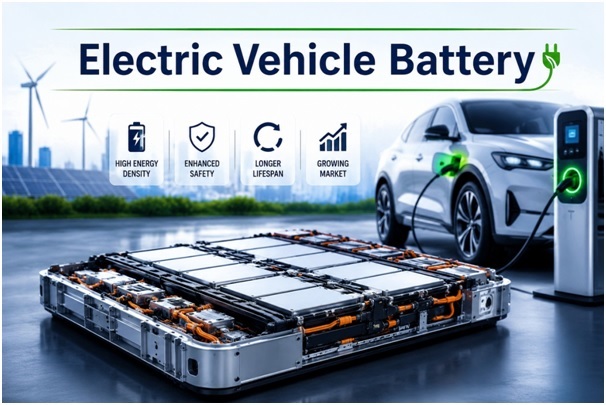
Battery cells serve as the fundamental energy storage units, while battery modules combine multiple cells into manageable structures. Battery packs integrate modules with cooling systems, electronic controls, and protective casings.
Battery Management Systems continuously monitor voltage, temperature, charging cycles, and overall battery health. Thermal management technologies regulate operating temperatures, preventing overheating and extending battery lifespan.
Advanced software algorithms further optimize energy consumption by predicting battery behavior under varying driving conditions, weather patterns, and charging environments.
Technological Innovations Reshaping the Market
Innovation remains the strongest growth driver within the Electric Vehicle Battery Market. Manufacturers are investing heavily in improving battery chemistry, manufacturing efficiency, and material sustainability.
Solid-state batteries are attracting significant attention due to their potential for higher energy density, faster charging, and improved safety compared to conventional lithium-ion batteries. Although commercialization is still progressing, these batteries could redefine vehicle performance over the coming decade.
Silicon-enhanced anodes are increasing energy storage capacity while reducing charging times. Advanced cathode materials continue to improve battery stability and extend operational lifespan.
Artificial intelligence is also transforming battery development by accelerating material discovery, optimizing production quality, predicting battery degradation, and enhancing manufacturing efficiency.
Digital twins and machine learning models allow manufacturers to simulate battery performance before physical production, significantly reducing development timelines
Sustainability Is Becoming a Competitive Advantage
Environmental responsibility has evolved into a major competitive differentiator within the battery industry. Manufacturers increasingly recognize that sustainable production practices influence consumer trust, investor confidence, and regulatory compliance.
Battery recycling technologies are recovering valuable materials such as lithium, nickel, cobalt, manganese, copper, and graphite from end-of-life batteries. These recovered materials reduce mining dependency while lowering environmental impact.
Many organizations are also adopting circular economy strategies where battery materials continuously re-enter manufacturing cycles instead of becoming industrial waste.
Renewable-powered battery factories, low-carbon manufacturing processes, water conservation technologies, and ethical mineral sourcing initiatives are becoming integral parts of long-term corporate strategies.
Regional Developments Driving Market Expansion
The Electric Vehicle Battery Market demonstrates strong global momentum, although regional priorities differ based on industrial capabilities and policy frameworks.
Asia continues to lead battery manufacturing due to extensive production infrastructure, technological expertise, and integrated supply chains. Continuous investments in battery gigafactories strengthen manufacturing capacity while supporting domestic electric vehicle industries.
Europe is emphasizing battery independence through localized manufacturing, research collaborations, and sustainable production standards. Investments focus on reducing import dependence while building resilient supply chains.
North America is accelerating battery investments through domestic manufacturing initiatives, technological innovation, and strategic partnerships aimed at strengthening regional competitiveness.
Emerging economies across Latin America, the Middle East, Africa, and Southeast Asia are gradually expanding their participation through raw material processing, battery assembly, renewable energy integration, and infrastructure development.
How Artificial Intelligence Is Transforming Battery Manufacturing
Artificial intelligence has become one of the most valuable technologies supporting battery innovation. AI-powered quality inspection systems detect microscopic manufacturing defects that would be difficult for human inspectors to identify.
Predictive maintenance algorithms minimize equipment downtime by identifying potential machine failures before production interruptions occur. AI also assists engineers in discovering new battery materials capable of delivering higher energy density and improved safety characteristics.
Machine learning further optimizes charging behavior by analyzing user driving habits, environmental conditions, and battery degradation patterns, helping maximize battery lifespan throughout vehicle ownership.
Challenges That Continue to Shape Industry Development
Despite remarkable progress, the Electric Vehicle Battery Market faces several ongoing challenges that influence investment decisions and technological priorities.
Critical mineral availability remains a significant concern as global demand for lithium, nickel, cobalt, and graphite continues to increase. Building resilient and diversified supply chains has become essential for maintaining production stability.
Battery manufacturing requires substantial capital investments, highly specialized engineering expertise, and strict quality control systems. Maintaining affordability while continuously improving battery performance presents an ongoing balancing act for manufacturers.
Charging infrastructure expansion, battery recycling capacity, raw material price volatility, and evolving environmental regulations also require coordinated efforts among governments, manufacturers, technology providers, and energy companies.
Emerging Opportunities Creating Long-Term Value
Future opportunities extend well beyond passenger electric vehicles. Commercial transportation, heavy-duty trucks, electric buses, marine vessels, aviation electrification, agricultural equipment, and industrial machinery are all increasing demand for advanced battery technologies.
Battery-as-a-Service business models are making electric mobility more accessible by separating battery ownership from vehicle ownership. This approach reduces upfront costs while improving battery lifecycle management.
Vehicle-to-Grid (V2G) technology represents another promising opportunity. EV batteries can temporarily supply electricity back to power grids during peak demand periods, transforming vehicles into decentralized energy storage assets.
Second-life battery applications are also expanding rapidly, allowing retired EV batteries to serve stationary energy storage systems for homes, commercial buildings, and renewable energy projects.
Future Outlook
According to our Growth Market Report,The future of the Electric Vehicle Battery Market extends beyond simply producing more powerful batteries. The industry is evolving toward intelligent, sustainable, and digitally connected energy storage ecosystems capable of supporting transportation, renewable energy integration, and resilient power infrastructure simultaneously. Continued advancements in battery chemistry, artificial intelligence, circular economy practices, and localized manufacturing are expected to redefine global competitiveness while accelerating the worldwide transition toward cleaner mobility. Organizations that successfully combine technological innovation, environmental
responsibility, and supply chain resilience will be well positioned to shape the next generation of electrified transportation and energy systems.
Source:- https://growthmarketreports.com/report/electric-vehicle-battery-market-global-industry-analysis