


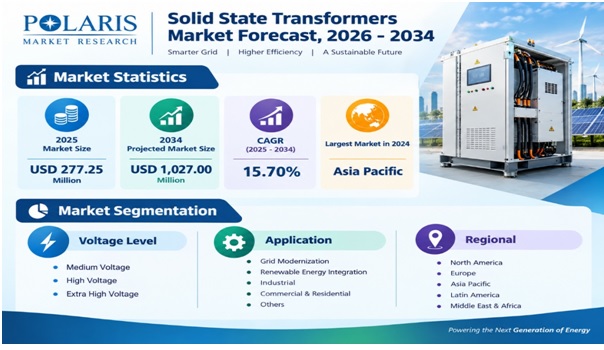
For more than a century, the transformer has been the least glamorous device on the grid — a steel-and-copper box that simply changed voltage and asked nothing else of the system. That era is ending. As grids absorb more solar, wind, and electric vehicles, utilities are discovering that a passive transformer can’t keep up with power that no longer flows in one predictable direction. Solid state transformers (SSTs) — semiconductor-based devices that actively manage power rather than just converting it — are stepping into that gap. The global solid state transformers market, valued at USD 240.49 million in 2024, is projected to reach USD 1.03 billion by 2034, growing at a 15.7% CAGR. Behind that number is a real shift in how power infrastructure gets designed.
The Industry Shift Behind the Market
Conventional transformers were built for a grid where power moved one way, from large plants down to consumers. That assumption no longer holds. Rooftop solar pushes power backward into distribution lines, wind farms generate in unpredictable bursts, and EVs pull sudden loads at odd hours. Solid state transformers respond by replacing passive magnetic cores with power electronics that sense and redirect electricity in real time. That bidirectional capability is what has moved SSTs from a research curiosity into a procurement conversation, reinforced by regulatory momentum — including an $18 million U.S. Department of Energy initiative launched in 2024 to advance next-generation transformer technology.
What the Market Means for Businesses
For utilities, the appeal is direct: SSTs are smaller, generate fewer losses, and flex to accommodate the swings renewables and EV charging introduce. That’s reshaping capital budgets, with spending shifting toward smart-grid-compatible hardware rather than like-for-like replacement of aging equipment.
For more information, visit @ https://www.polarismarketresearch.com/industry-analysis/solid-state-transformers-market
The opportunity reaches well beyond substations. In EV charging, SSTs enable faster, more efficient power conversion, already visible in ultra-fast charging pilots. In manufacturing, they offer tighter control over power quality as factories electrify processes once run on fossil fuels. For semiconductor makers, rising SST demand extends existing power-electronics roadmaps into a high-value adjacent market.
The catch is cost. SSTs remain considerably more expensive upfront than conventional units, and that premium is the central obstacle slowing broader adoption. Businesses need to weigh it against lifecycle efficiency gains — a calculation that looks different for a utility running decades-long asset cycles than for a charging network competing on speed today.
Regional Market Dynamics
Asia Pacific led the market in 2024, driven by rapid industrialization across China, India, and Japan and the region’s dominance in EV manufacturing, which feeds directly into demand for SST-based charging equipment. China’s 2024 move to build hybrid AC/DC grid infrastructure in Jiangsu Province shows how closely national energy strategy and SST adoption are now linked.
North America’s growth story is different — built less on scale and more on early adoption. A concentration of established manufacturers and research institutions, paired with federal clean-energy support, has made the region a proving ground for new applications, exemplified by Delta Electronics’ 400-kilowatt SST-based ultra-fast EV charger, developed with U.S. DOE collaborators. For businesses, that split suggests two entry strategies: manufacturing scale in Asia Pacific, technology partnerships in North America.
Competitive Landscape and Innovation
The competitive field mixes established power and semiconductor giants — Siemens, ABB, Toshiba, Infineon, and STMicroelectronics among them — with smaller specialized players. Much of the innovation sits at the intersection of power electronics and grid software, as companies work to make SSTs not just functional but cost-competitive.
Hitachi Energy manufacturing its 1,000th WindSTAR transformer, built for offshore wind integration, signals a move from pilot deployments toward volume production. Schneider Electric’s 2024 smart grid announcements point to a parallel trend: vendors increasingly sell SSTs as part of broader grid-management platforms rather than standalone hardware. ABB’s newer circuit breakers, built with predictive-maintenance analytics and embedded cybersecurity, reflect a fresh pressure point — as power equipment gets smarter and more connected, it also becomes something that needs securing.
What Comes Next: Future Outlook
The automotive segment, encompassing EV charging infrastructure, is expected to grow fastest through 2034, reflecting how tightly SST adoption is bound to transport electrification. Vehicle-to-grid technology, where EVs feed power back during peak demand, should accelerate this further, since it depends on the same bidirectional management SSTs are built for.
At the grid level, HV/MV applications will likely keep drawing investment, since that’s where SSTs deliver the clearest reliability gains today. The cost curve is the variable worth watching: as production scales and semiconductor costs fall, economics that currently favor only the most demanding applications should open up to a wider range of grid and industrial uses.
Conclusion: The Bigger Business Picture
Solid state transformers matter less as a market opportunity than as a signal of where power infrastructure is headed — toward hardware built to sense and respond to variable power flow, not just carry it. For utilities, manufacturers, and technology suppliers, the real question isn’t whether SSTs eventually matter, but how quickly to move given today’s cost premium. The businesses that get that timing right, positioning early in high-value applications like EV fast-charging and offshore wind, are likely to be the ones setting the terms of a market still in its formative decade.
Read More @ https://www.polarismarketresearch.com