


Market Summary
According to latest research by Growth Market Reports, the global piezoresistive pressure sensors market size reached USD 2.63 billion in 2025, reflecting robust expansion driven by technological advancements and increasing demand across multiple sectors. The market is experiencing a healthy CAGR of 7.2% and is projected to attain a value of USD 4.87 billion by 2034. This growth is primarily attributed to the expanding adoption of smart sensor technologies, rising integration in automotive safety systems, and the proliferation of connected devices in industrial and healthcare applications. As per our comprehensive analysis, the piezoresistive pressure sensors market is set to witness sustained momentum, supported by ongoing innovations and a growing emphasis on automation and digitalization worldwide.
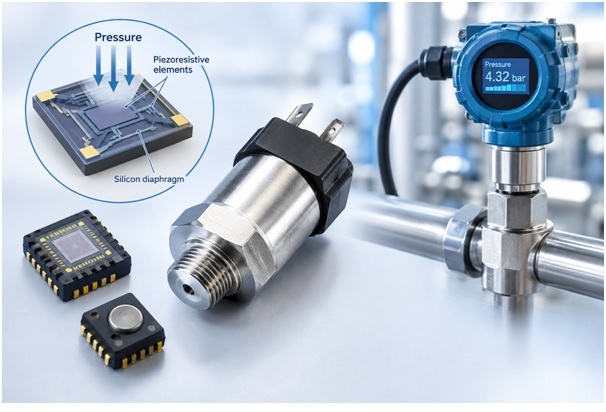
The Piezoresistive Pressure Sensors Market is gaining momentum as industries increasingly rely on accurate, compact, and responsive pressure measurement technologies. Piezoresistive sensors operate by detecting changes in electrical resistance caused by mechanical deformation, converting applied pressure into measurable electrical signals. Their established technology, relatively simple signal conditioning, and compatibility with MEMS manufacturing have supported broad adoption across automotive, healthcare, industrial, aerospace, and consumer applications.
Key Drivers
Growing Adoption Across Automotive Applications
Automotive systems represent an important area of demand for piezoresistive pressure sensing. Pressure measurement supports applications such as tire pressure monitoring, engine management, braking systems, and other vehicle control functions. The increasing integration of electronic systems into conventional and electric vehicles is creating additional opportunities for compact and reliable pressure sensors.
As vehicle architectures become more electronically controlled, pressure sensors are increasingly expected to deliver consistent measurements under changing temperature, vibration, and operating conditions. Manufacturers are therefore focusing on sensor designs that combine durability, miniaturization, accuracy, and efficient signal processing.
Industrial and Healthcare Demand
Industrial automation is another significant application area for piezoresistive pressure sensors. These devices can monitor hydraulic and pneumatic systems, manufacturing processes, fluid lines, and equipment conditions. Their ability to provide continuous pressure information can support process control, equipment diagnostics, and preventive maintenance strategies.
Healthcare applications are also expanding as pressure sensing becomes increasingly important in medical instrumentation. Sensors can be incorporated into blood-pressure monitoring equipment, respiratory systems, catheters, and other medical devices where compact and responsive pressure measurement is required.
Technological Advancements Reshape Sensor Design
Technological development is transforming the capabilities of piezoresistive pressure sensors. MEMS fabrication enables manufacturers to create increasingly compact sensing structures while supporting high-volume production. Silicon-based designs remain important because of their established manufacturing ecosystem and compatibility with integrated electronics.
Research is also moving toward advanced materials and flexible architectures. Recent developments include silicon-on-insulator structures, graphene, MXenes, conductive polymer composites, and other engineered materials. These approaches aim to improve sensitivity, durability, flexibility, and performance across specialized environments.
Challenges in the Piezoresistive Pressure Sensors Market
The Piezoresistive Pressure Sensors Market faces challenges related to temperature sensitivity, long-term stability, and environmental durability. Variations in temperature can influence the resistance of sensing elements and affect measurement accuracy, particularly in automotive, aerospace, and industrial environments. Sensors may also be exposed to vibration, humidity, mechanical stress, and corrosive conditions, requiring robust materials, protective packaging, and effective calibration to maintain reliable performance.
Another challenge involves miniaturization, manufacturing complexity, and cost pressures. As industries demand smaller sensors with greater sensitivity and integrated functionality, manufacturers must balance compact designs with durability and consistent signal quality. Advanced MEMS fabrication, packaging, testing, and calibration can increase production complexity. Maintaining high manufacturing consistency while meeting cost requirements remains important for broader adoption across high-volume applications.
Emerging Opportunities in Smart and Flexible Electronics
The expansion of connected devices presents additional opportunities for the market. Pressure sensors can provide physical measurements that are subsequently processed by digital systems, enabling more responsive monitoring and automation. Integration with connected platforms can support applications ranging from industrial equipment monitoring to intelligent consumer devices.
Flexible piezoresistive sensors are attracting particular research interest for wearable electronics, human-machine interfaces, electronic skin, and soft robotics. Advances in microstructured surfaces, conductive networks, and flexible materials are helping researchers address the performance requirements of these emerging applications.
Competitive Landscape
Honeywell International Inc.
TE Connectivity Ltd.
Bosch Sensortec GmbH
STMicroelectronics N.V.
NXP Semiconductors N.V.
Sensata Technologies, Inc.
Amphenol Advanced Sensors
Infineon Technologies AG
Omron Corporation
Future Outlook
The future of the Piezoresistive Pressure Sensors Market is expected to be shaped by continued miniaturization, MEMS integration, advanced materials, flexible electronics, and intelligent sensing systems. As automotive, industrial, healthcare, and connected-device applications become increasingly data-driven, demand for dependable pressure measurement is likely to remain significant.
Continued innovation will focus on improving sensitivity, temperature compensation, long-term stability, energy efficiency, and resistance to demanding operating environments. The combination of established piezoresistive technology with new materials, advanced architectures, and digital processing is creating new possibilities for next-generation pressure sensing across a diverse range of industries.