


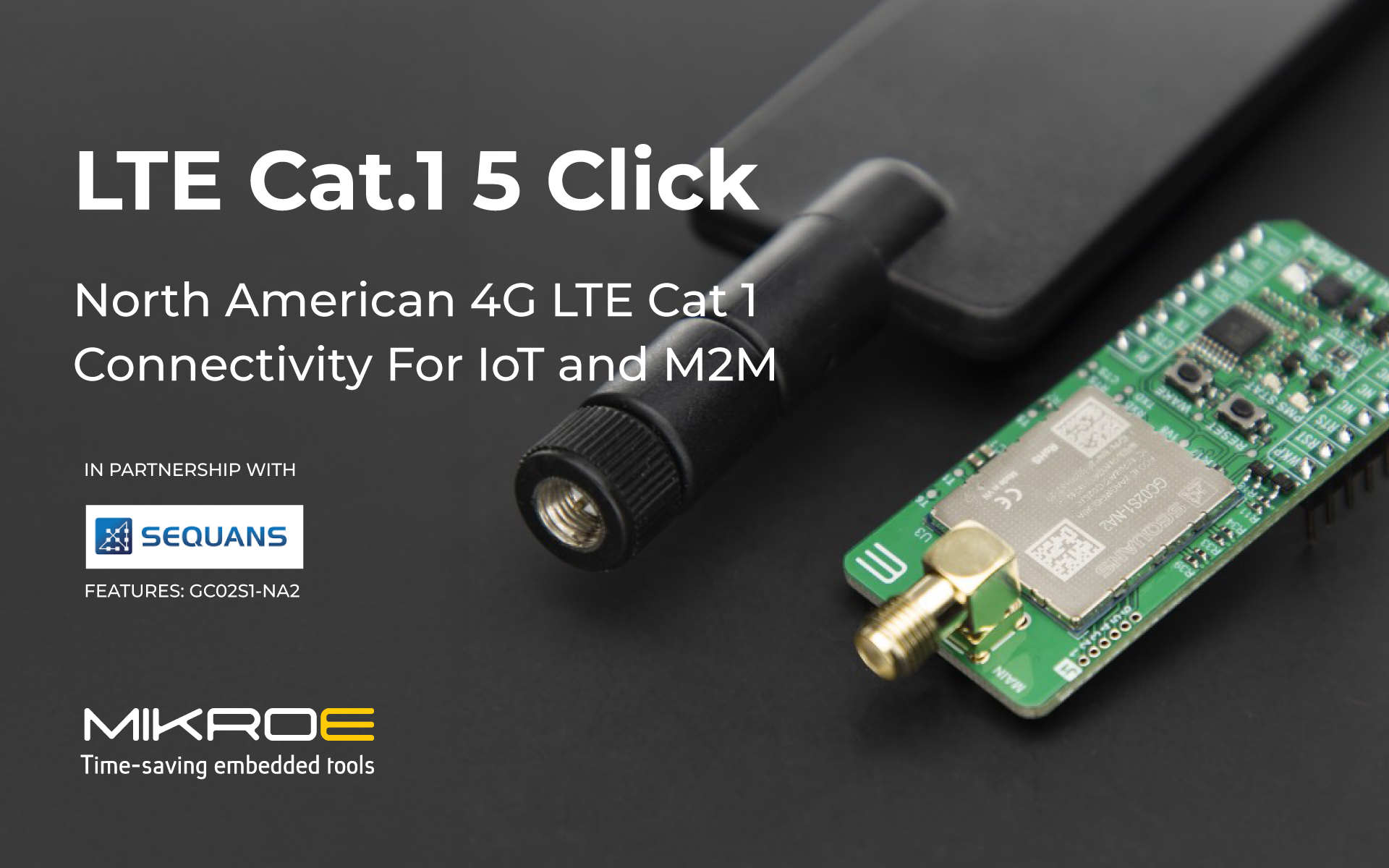
Add 4G LTE Cat 1 bis connectivity where reliable data transmission and low power consumption are critical with the GC02S1-EU2 module
LTE Cat.1 5 Clickis a new cellular wireless connectivityClick board™from MIKROE, the embedded solutions company thatdramatically cuts development time by providing innovative hardwareand software products based on proven standards. The compact Click add-on boards enable developers to rapidly provide proof-of-concept, then prototypeand code new embedded projects. LTE Cat.1 5 Click (for Europe)provides 4G LTE Cat 1 bis cellular connectivity tailored for European IoT, M2M and consumer applicationswhere reliable data transmission and low power consumption are critical.
Comments Nebojsa Matic, CEO of MIKROE: “This new Click board is well suited for utility meters, industrial sensors, security and alarm systems, payment terminals, asset trackers, smart home devices, smart metering infrastructure, and wearable consumer applications. It is part of our 269+ strong family of wireless connectivity Click boards and over 875projects – with working code – featuring the LTE Cat.1 5 Click can be found on MIKROE’s embedded projects platform,EmbeddedWiki.”
LTE Cat.1 5 Click is based on the GC02S1-EU2, a 3GPP LTE Release 14 Cat 1 bis compliant module from Sequans,featuring optimized Calliope 2 silicon for improved performance and reduced power consumption. Tailored for the European market, it features support for LTE bands B1, B3, B8, B20 and B28 across approximately 703MHz to 2170MHz, data rates up to 10Mbps downlink and 5Mbps uplink, UART communication interface, firmware upgrade support, hardware flow control, wake and reset functions, debug access through UART1 and JTAG, and 1.8V uSIM card support.
LTE Cat.1 5 Click is a recent addition to MIKROE’s1975-strong mikroBUS™-enabled Click boardfamily. The boardalsofeatures the ClickID function which enablesautomatic identification by the host system, simplifying use.Devices can be used on any host system supporting the mikroBUS™ standard, and come with the mikroSDK open-source libraries, offering excellent flexibility for evaluation and customization.