


- Swiss researchers at CSEM and EPFL spin-off ORYL Photonics have overcome a bottleneck in drug development.
- It is now possible to perform solubility tests up to 100 times faster and at one-tenth of the previous cost.
- Moreover, the method requires much smaller quantities of chemical solvents and reduces sample material use by a factor of up to 100.
- As partners on the project, CSEM and ORYL Photonics have jointly been awarded the EARTO Innovation Award 2026 for this breakthrough
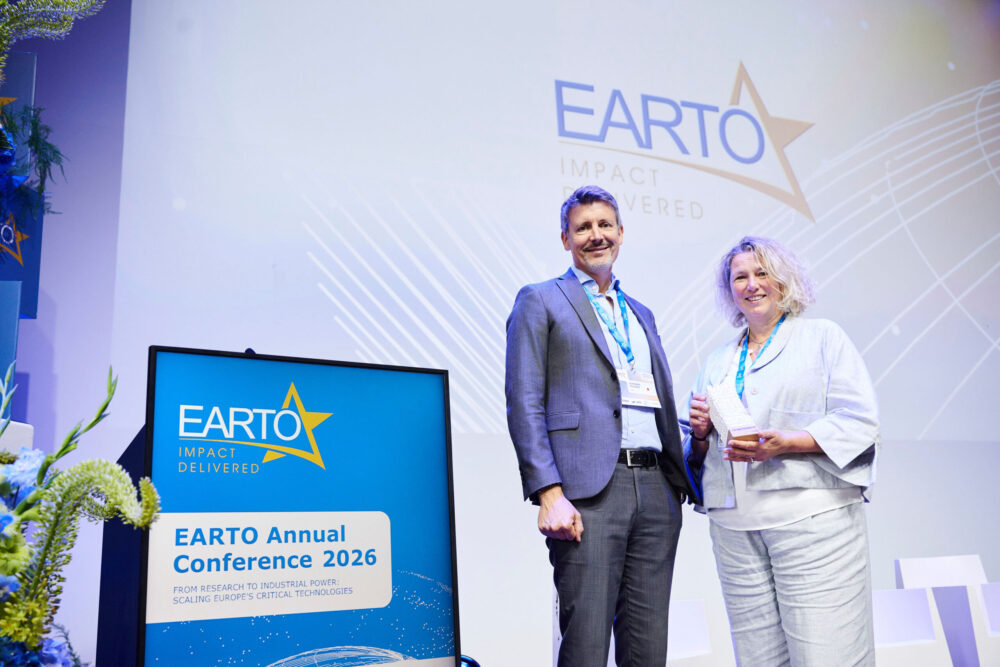
CSEM was awarded the EARTO Innovation Award in the “Impact Expected” category on June 10, 2026 for its work on the development of a promising test for new drugs. The method, developed in collaboration with ORYL Photonics, is not only faster and more cost-effective, but also more sustainable than methods used up to now.
Bringing new medicines to patients as quickly as possible is a key goal of pharmaceutical research. An essential step in this process is solubility testing, which determines how well active pharmaceutical ingredients dissolve in liquids. However, this stage often represents a bottleneck in early drug development, as conventional testing methods are both time-consuming and resource-intensive.
Together with EPFL spin-off ORYL Photonics, CSEM developed an industrial prototype for high-throughput solubility testing that bridges the gap between laboratory research and industrial application, resulting in a reliable, cost-effective, and scalable solution. The independent jury convened for the EARTO Innovation Awards 2026 has now awarded this project first prize in the “Impact Expected” category, which recognizes innovations with strong potential for future impact. The award ceremony took place on June 10 as part of the EARTO Annual Conference 2026 in Brussels.
“We are delighted to receive this award in recognition of our collaboration with ORYL Photonics,” states Stefano Cattaneo, Group Leader Optoelectronic Systems at CSEM. “It highlights how innovative measurement concepts can be successfully transferred from the lab into robust, scalable solutions for the pharmaceutical industry.”
Trading complex separation processes for light
In traditional solubility tests, the active ingredient is dissolved in a liquid and forced through long capillaries at high pressure to separate the components so they may be analyzed. Known as high-performance liquid chromatography (HPLC), this technique is both time-consuming and requires a substantial amount of valuable sample material—right at the stage where every milligram of a new active ingredient counts and further testing relies on available material. Furthermore, the technique needs large quantities of chemical solvents, which are harmful to the environment.
The innovative process developed by CSEM and ORYL Photonics overcomes these disadvantages by using light to assess solubility. This method uses a laser to send ultra-short light pulses through the liquid containing the active ingredient. If the active substance is fully dissolved, the laser pulse will pass through the solution unimpeded. Otherwise, scattered signals are generated at the laser frequency as well as higher frequencies, which are detected by the system. The system is so sensitive that it is able to pick up undissolved substances at concentrations that conventional methods would struggle to observe.
Less material, fewer chemicals, more time saved
The principle behind this measurement method was developed by EPFL and ORYL Photonics. Together with CSEM, the method has now been translated into an application-ready prototype, leveraging the CSEM team’s expertise in optics, electronics, system design, and automation.
The prototype is capable of simultaneously analyzing hundreds of samples in 384-well microtiter plates in just 15 minutes, with highly reliable results. Furthermore, only minimal quantities of the active ingredient are required for analysis—around one hundred times less than with the previous method, in fact. It also significantly reduces the quantity of chemical solvents needed. Orly Tarun, founder and CEO of ORYL Photonics, estimates that, if the innovation were rolled out on a global scale, it could save up to 70 million liters of solvent and 4.7 TWh of electricity, equivalent to around 8% of Switzerland’s annual energy consumption.
A faster, greener route to new drugs
“This method enables solubility tests to be performed 100 times faster at approximately one-tenth the cost,” explains Orly Tarun, highlighting its potential to significantly reduce research and development costs in the pharmaceutical industry. The method can be used in conjunction with a wide range of drug classes and conditions and is scalable for high-throughput screening. This facilitates the identification of promising drug candidates earlier in the pharmaceutical research cycle while decreasing development risks and accelerating drug delivery.
In 2021, CSEM received an EARTO Innovation Award for its collaboration with the startup CUTISS, which uses biotechnology to produce personalized skin grafts for people with severe burns. The two awards stand as testament to CSEM’s ability to transfer innovations from the laboratory to real-world settings and facilitate their deployment on an industrial scale.