



BY :TME
Effective control and reliable protection.
Power electronics systems must not only efficiently control the flow of energy but also handle phenomena that may threaten their components. In converters, inverters, power supplies, or drive systems, semiconductors frequently switch large currents and operate at high voltages. At the same time, they may be exposed to overvoltages originating both from the power grid and generated within the device itself.
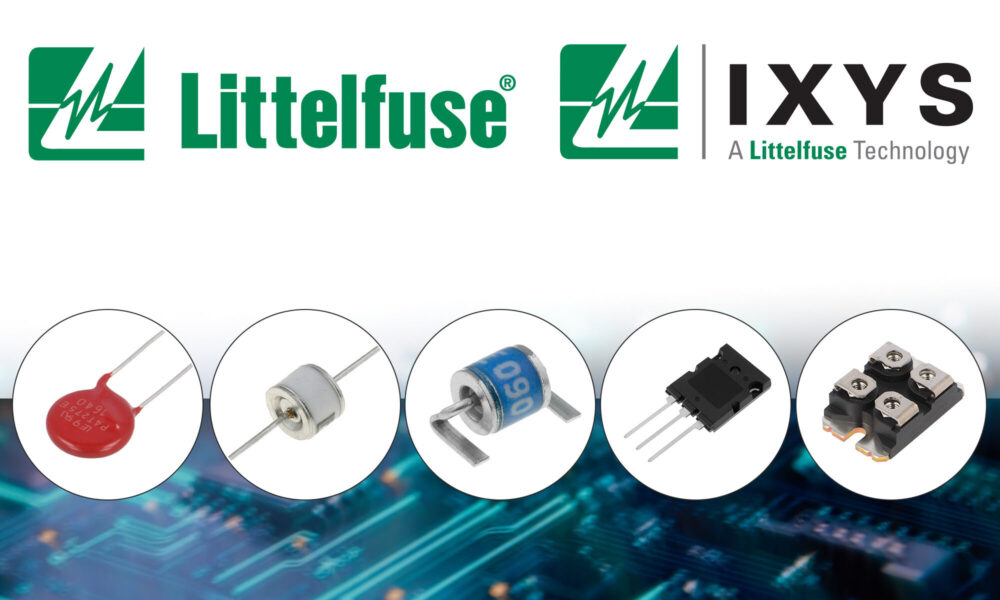
Solutions from Littelfuse available at TME include both components used for controlling and converting energy and elements for protecting systems against overvoltages. The brand IXYS owned by the manufacturer specializes, among other things, in power semiconductors – diodes, MOSFETs, and IGBTs. Complementing these are Littelfuse solutions designed for overvoltage protection, including varistors and gas discharge tubes (GDT).
Fast diodes where switching losses also matter
In rectifier and converter circuits, a diode does not always operate at network frequency. In switching power supplies or converters, it can very quickly transition between conducting and blocking states, so besides permissible current and voltage, its dynamic parameters become important.
For such applications, TME offers IXYS diode modules like DSEI2X61-04C, DSEI2X61-10B, and DSEI2X61-12B. These are fast diodes from the FRED (Fast Recovery Epitaxial Diode) family, characterized by a short recovery time. Reducing switching losses translates into less heat generation and allows increasing the efficiency of systems operating at high frequencies.
MOSFET modules from IXYS
Many more variables arise when choosing MOSFET transistors. These components serve as very fast electronic switches and are used, among others, in DC/DC converters, switching power supplies, UPS power supplies, and drive control systems.
Among the IXYS products available at TME are both transistor modules, e.g., IXFN100N50P, IXFN132N50P3, IXFN210N20P, IXFN360N10T, and IXFN420N10T, as well as discrete transistors like IXFH170N25X3, IXFR48N60P, IXFX210N30X3, IXFX27N80Q, and IXTK120N25P. When selecting such products, several parameters need to be compared:
- maximum drain-source voltage,
- permissible drain current,
- RDS(on) resistance in the conducting state,
- switching parameters and losses,
- permissible junction temperature and cooling conditions,
- operating frequency and load characteristics.
Each of these affects the behavior of the transistor in a specific circuit. A low RDS(on) value allows reducing conduction losses, but in high-frequency systems, the transistor’s dynamic parameters may be equally important. In a high-voltage system, the primary limitation will be the required blocking voltage.
Importantly, these products are not based on a single MOSFET design. Among the models available at TME are solutions using various IXYS technologies, including:
- Polar,
- Polar3,
- X3-Class,
- Q-Class,
- Trench Gate.
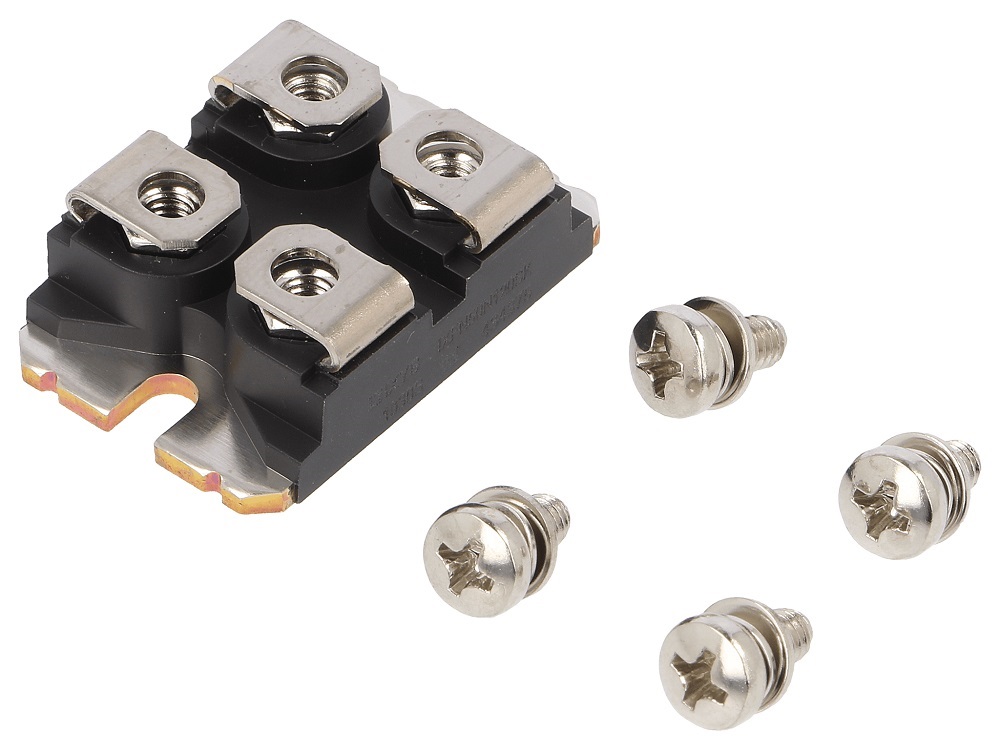
Unipolar module in HiPerFET™, Polar™ technology.
Different designs are intended for operation at various voltage, current, and frequency ranges, so two MOSFET transistors with seemingly similar basic parameters may behave differently in the same application.
Therefore, the selection should consider the entire operating cycle of the transistor. Oversizing the element solely in terms of maximum current will not solve the problem if switching losses dominate during actual operation or if the device design does not allow effective heat dissipation.
IGBT transistors in high-voltage systems
MOSFET is not the only solution used as a semiconductor power switch. IGBT transistors are also used in systems operating at high voltages.
Individual models differ primarily in permissible collector-emitter voltage and collector current, allowing them to be matched to different operating conditions. Two extreme examples illustrate this well: IXYK120N120C3 is adapted for operation at a collector-emitter voltage up to 1.2kV and a collector current of 120A, while IXGH2N250 reaches a voltage of up to 2.5kV at a collector current of 2A (at a case temperature of 110°C).
High voltage and current values alone do not determine the use of IGBT instead of MOSFET. When choosing, one must simultaneously consider voltage and current, switching frequency, power losses, and thermal conditions. Only by comparing these parameters with the requirements of a specific system can one decide which type of transistor will be appropriate.
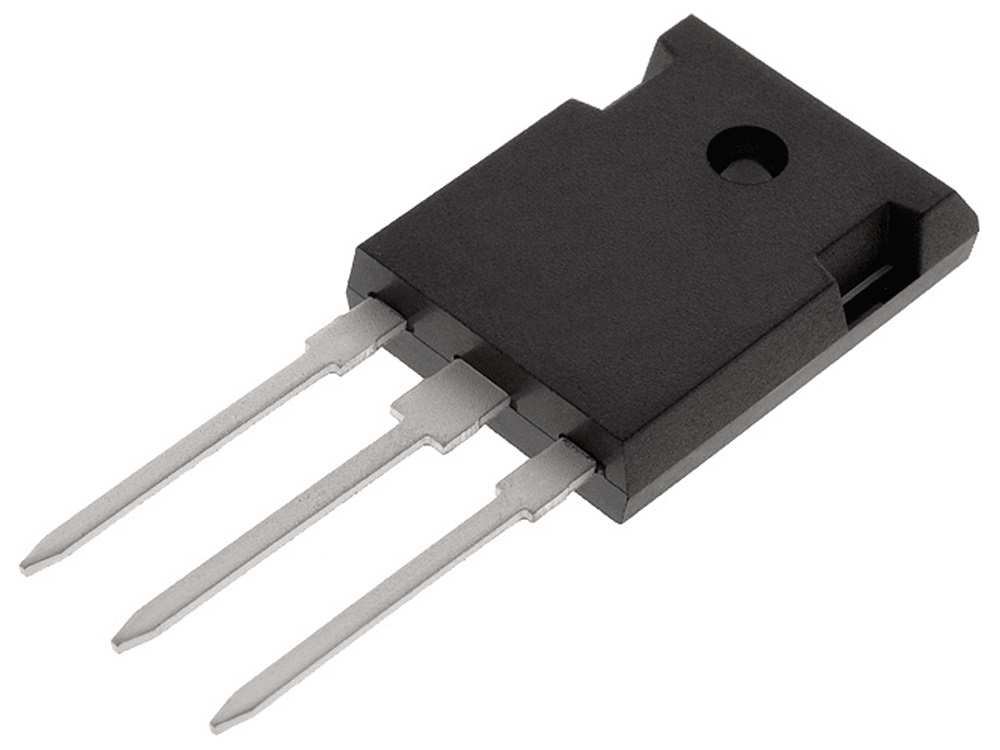
Turn-on time is 33ns, and turn-off time is 308ns.
Where do overvoltages come from, and why do semiconductors require protection?
Efficient power control is not enough if the switching element is exposed to voltage exceeding its permissible parameters. Such a threat can also arise in a properly designed and operated device. Sources of overvoltages can include:
- lightning strikes and overvoltages from the power grid,
- switching on and off inductive loads, e.g., motors, transformers, or contactor coils,
- sudden current changes occurring within the power electronics system.
An impulse can last very briefly but reach a voltage sufficient to damage the semiconductor or accelerate its degradation. Protection should absorb the disturbance energy or limit the voltage to a level safe for the protected electronics.
In TME’s offer, IXYS semiconductors are complemented by Littelfuse components designed for overvoltage protection. These include gas discharge tubes from the CG series and metal oxide varistors TMOV and LA.
GDT protectors and MOV varistors – similar goal, different operation
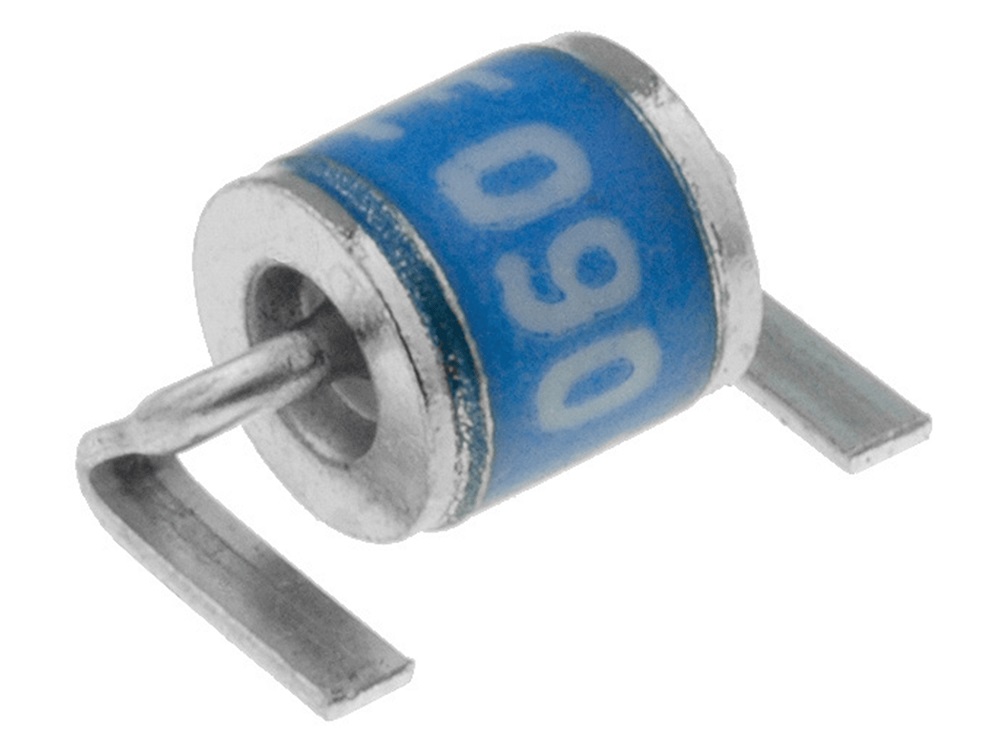
The element provides protection in many applications (audio/video inputs/outputs, data transmission systems, telecommunications devices).
Gas discharge tube (GDT) overvoltage protectors from the CG family have very high resistance during normal operation. When a specified voltage is exceeded, a discharge occurs, and the element begins to conduct surge current. The small capacitance means that GDTs can protect the circuit without significantly affecting transmitted signals. Littelfuse protectors from the CG family available at TME are used, among others, in data transmission systems, telecommunications devices, and for protecting audio and video inputs and outputs.
Metal oxide varistors (MOVs) operate differently. When a specified voltage is exceeded, their resistance decreases sharply, allowing them to conduct current and limit the overvoltage value. Among the Littelfuse products available at TME are varistors from the LA series. When selecting them, one considers primarily the maximum operating voltage, varistor voltage, permissible surge current, and pulse energy.
TME also offers TMOV varistors equipped with thermal protection. In case of excessive temperature rise, it allows disconnecting the varistor from the circuit, providing additional protection against the effects of overheating.
How to combine power control with proper protection?
Selecting components for a power electronics system requires considering both its normal operating conditions and potential disturbances. For MOSFETs and IGBTs, factors such as voltage, current, switching frequency, and power losses are important. Protective elements are selected considering the type and parameters of overvoltages the system may be exposed to. Different protection properties are required for protecting the power input from a strong external impulse and for limiting overvoltages generated during the operation of inductive elements. Therefore, it is not enough to separately select the appropriate semiconductor and protector, as their parameters should match the operating conditions of the same system.
Products from IXYS and Littelfuse available at TME include both semiconductors responsible for rectifying and switching energy and components for overvoltage protection. In both cases, the right choice depends not on a single parameter but on the requirements of the specific application.
Text prepared by Transfer Multisort Elektronik Sp. z o.o.