


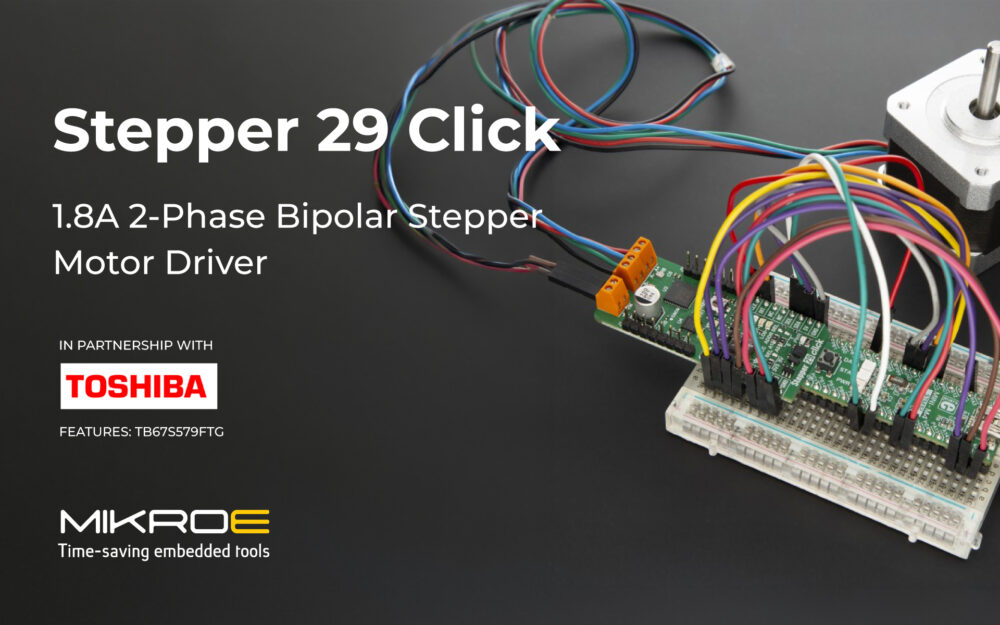
Control bipolar stepper motors with the TB67S579FTG, ensuring ultra-smooth motion and extremely low-noise operation
Stepper 29 Clickis a new motorcontrolClick board™from MIKROE, the embedded solutions company thatdramatically cuts development time by providing innovative hardwareand software products based on proven standards. The compact Click add-on boards enable developers to rapidly provide proof-of-concept, then prototypeand code new embedded projects. Stepper 29 Click provides control of bipolar stepper motors in motion control, automation, robotics and embedded positioning applications.
Comments Nebojsa Matic, CEO of MIKROE: “This new Click board is ideal for stepper motor control in office equipment likeprinters, scanners and copiers,as well as a range of commercial and industrial equipment, including vending machines, 3D printers, conveyor systems, robotic arms and CNC machines. It is part of our 145+ strong family of motor control Click boards and over 873projects – with working code – featuring the Stepper 29 Click can be found on MIKROE’s embedded projects platform,EmbeddedWiki.”
Stepper 29 Click is based on the TB67S579FTG, a PWM chopper-type 2-phase bipolar stepper motor driver IC from Toshiba Semiconductor,which supports a motor supply operating range from 4.5V to 34V with up to 1.8A output current, enabling motor drive using a single VM supply thanks to the integrated internal regulator. It features manual current threshold adjustment, integrated protection mechanisms, configurable step resolutions up to 1/32 microstepping, flexible decay mode selection and extended configuration through a I2C port expander for advanced driver control. The Click board features advanced microstepping with continuous sine-wave phase current for ultra-smooth, low-noise operation, even at full-step mode. It also includes AGC 2nd generation for automatic current regulation and integrated stall detection to prevent motor stalls.
Stepper 29 Click is a recent addition to MIKROE’s1970-strong mikroBUS™-enabled Click boardfamily. The boardalsofeatures the ClickID function which enables automatic identification by the host system, simplifying use.Devices can be used on any host system supporting the mikroBUS™ standard, and come with the mikroSDK open-source libraries, offering excellent flexibility for evaluation and customization.