

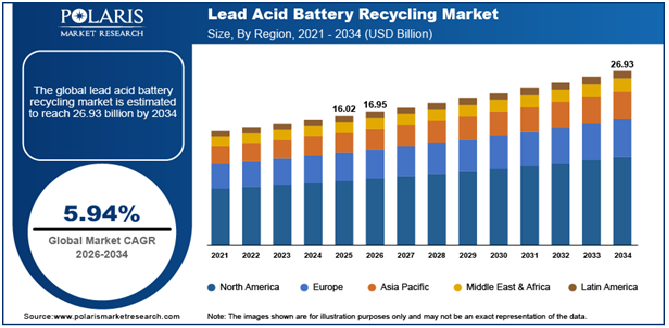
The global Lead Acid Battery Recycling Market is witnessing steady expansion, emerging as a cornerstone of the circular economy within the chemicals & materials industry. According to insights from Lead Acid Battery Recycling Market Report, the market was valued at USD 16.02 billion in 2025 and is projected to reach USD 26.93 billion by 2034, growing at a CAGR of 5.94% during the forecast period.
This growth trajectory highlights the increasing importance of sustainable material recovery, regulatory compliance, and secondary lead production in global supply chains.
Market Overview: A Closed-Loop Recycling Success Story
Lead acid battery recycling represents one of the most efficient recycling systems globally, with recovery rates exceeding 95%, making it a benchmark model for circular economy practices. The process involves collecting used batteries, separating components such as lead, plastic, and electrolyte, and reintroducing them into the manufacturing cycle.
This closed-loop system significantly reduces dependency on primary lead mining while minimizing environmental hazards associated with improper disposal. As industries increasingly prioritize sustainability, the adoption of recycling technologies is becoming a strategic imperative across automotive, telecom, and industrial sectors.
Strong Market Drivers Fueling Expansion
- Rising Automotive Battery Replacement Cycles
The automotive sector remains the dominant contributor to recycling demand. Lead acid batteries used in starter, lighting, and ignition (SLI) applications have limited lifespans, ensuring continuous replacement and scrap generation.
With global vehicle parc expanding and aging fleets increasing replacement frequency, the recycling ecosystem benefits from a consistent and predictable supply of used batteries.
- Stringent Environmental Regulations
Governments worldwide are enforcing strict hazardous waste management policies to control lead contamination. Regulatory frameworks mandate proper collection, transportation, and recycling of used batteries, strengthening formal recycling channels.
These regulations not only reduce environmental risks but also drive investments in licensed recycling facilities and advanced processing technologies.
- Growth in Stationary Energy Storage
The increasing reliance on backup power systems in telecom towers, data centers, and industrial infrastructure is expanding the installed base of lead acid batteries. This trend is expected to generate substantial future recycling volumes, particularly in emerging economies where grid reliability remains a concern.
Technology Landscape: Transition Toward Cleaner Processes
The market is currently dominated by pyrometallurgical recycling, which utilizes high-temperature smelting for bulk lead recovery. Its cost efficiency and established infrastructure make it the preferred choice across major recycling hubs.
However, hydrometallurgical processes are gaining traction due to their lower emissions and improved environmental performance. As regulatory scrutiny intensifies, industry players are increasingly investing in cleaner technologies to align with sustainability goals.
This shift reflects a broader trend within the chemicals sector—balancing operational efficiency with environmental compliance.
Segment Insights: Automotive Leads, Telecom Gains Traction
By battery type, SLI batteries accounted for the largest market share in 2025, driven by frequent replacements in passenger and commercial vehicles.
From an end-user perspective, the automotive sector dominates, supported by well-established collection networks and strong aftermarket demand. Meanwhile, the telecom segment is emerging as a high-growth area, fueled by rural connectivity expansion and increased deployment of backup power systems.
Regional Outlook: Asia Pacific at the Forefront
Asia Pacific leads the global market, supported by robust vehicle production, expanding industrialization, and well-developed secondary lead smelting capacity. Countries such as China and India are key contributors due to their large automotive base and growing infrastructure investments.
Europe is expected to register the fastest growth, driven by stringent recycling regulations, circular economy policies, and strong environmental governance.
North America holds a significant share, benefiting from structured collection systems, high vehicle ownership, and regulatory enforcement.
View More Information @ https://www.polarismarketresearch.com/industry-analysis/lead-acid-battery-recycling-market/request-for-sample
Challenges: Cost Pressures and Compliance Burdens
Despite strong growth prospects, the industry faces several challenges. High costs associated with environmental compliance—including air filtration systems, wastewater treatment, and safety protocols—can impact profitability, particularly for small and medium-scale recyclers.
Additionally, fluctuations in lead prices and the gradual shift toward alternative battery chemistries, such as lithium-ion, may influence long-term demand dynamics.
Competitive Landscape: Moderately Consolidated Market
The lead acid battery recycling market features a mix of global players and regional recyclers operating within regulated frameworks. Key companies are focusing on:
- Enhancing recovery efficiency
- Expanding collection infrastructure
- Investing in emission control technologies
- Securing long-term supply agreements
Major players include Aqua Metals Inc., Clarios, ECOBAT, EnerSys, Exide Industries Ltd., Glencore, Gravita India Ltd., and Umicore.
Recent developments, such as facility expansions and regulatory approvals, indicate continued investment in strengthening recycling capacity and supply chain resilience.
Future Outlook: Circular Economy Driving Long-Term Growth
The Lead Acid Battery Recycling Market is poised for stable and sustainable growth, underpinned by regulatory support, technological advancements, and increasing awareness of environmental responsibility.
The transition from informal recycling practices to formalized, licensed ecosystems is expected to unlock new investment opportunities and improve material recovery efficiency.
Moreover, the integration of recycling within broader circular economy frameworks will play a critical role in ensuring resource security and reducing environmental impact across industries.
Conclusion: A Strategic Market for Sustainable Materials
As industries move toward greener and more resource-efficient operations, lead acid battery recycling stands out as a mature yet evolving segment within the chemicals & materials sector. With strong fundamentals, regulatory backing, and expanding application areas, the market offers compelling opportunities for stakeholders across the value chain.
Read More @ https://www.polarismarketresearch.com