


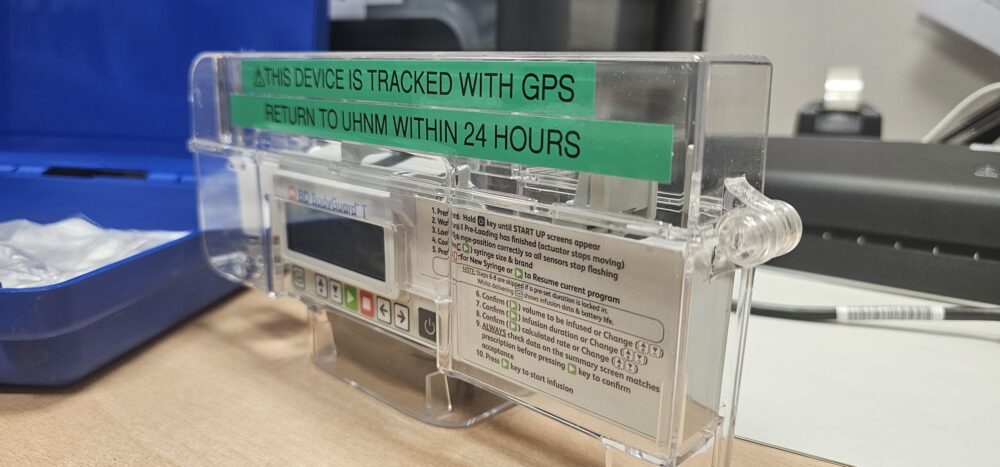
RFiD Discovery, a leading provider of medical device tracking solutions, has launched a GPS and Wi-Fi enabled tracking system for BodyGuard™ T (formerly T34) infusion pumps, giving healthcare providers real-time visibility of devices used both in hospitals and in the community.
Designed to support hospital, hospice and community care pathways, the solution enables clinical and engineering teams to track infusion pumps once they leave hospital sites – a long-standing challenge in palliative and end-of-life care.
The technology has already been successfully deployed by several NHS organisations, including University Hospitals of North Midlands NHS Trust (UHNM), where it has eliminated syringe pump losses entirely, paid for itself within weeks and improved patient flow for palliative and end-of-life care.
Solving a critical community care challenge
BodyGuard™ T infusion pumps are widely used to support patients receiving care at home or in community settings. However, once devices leave hospital estates, many providers lose visibility of their location. This can lead to equipment shortages, delayed discharges, increased costs and pressure on staff and services.
UHNM faced this challenge following the rollout of a new fleet of BodyGuard™ T syringe pumps. Within nine months, forty pumps were lost, each costing approximately ?2,500 to replace, impacting patient choice and discharge processes.
A proven GPS tracking solution
RFiD Discovery’s solution combines a medical-grade lockbox with an advanced GPS tracking tag, providing real-time location data both on-site and in the community. The lockbox is compatible with manufacturer-supplied locking barrels and keys, ensuring no disruption to existing clinical workflows.
At UHNM, the GPS tracking solution was integrated into the Trust’s existing RFiD Discovery platform, which already tracks tens of thousands of medical devices across multiple hospital sites using RFID technology.
Arron Duddin, General Manager at RFiD Discovery, commented:
“Pumps going missing once in the community is a persistent frustration for many hospitals. When devices can’t be found, discharges are delayed and staff are put under unnecessary pressure. By providing clear, real-time visibility without changing how teams work, this solution helps protect vital equipment and support better care.”
Immediate impact and measurable results
Since introducing GPS tracking in mid-2025, UHNM has transformed the way it manages its BodyGuard ™ T syringe pump fleet. Real-time mapping and automated alerts allow teams to identify when devices remain in the community beyond expected timeframes and recover them quickly.
Adam Broadhurst, Specialist Medical Engineer at University Hospitals of North Midlands NHS Trust, explains:
“Since implementing GPS tracking, we haven’t lost a single BodyGuard™ T syringe pump. The system has transformed the service and completely stabilised our fleet.”
UHNM estimates the solution has already avoided over ?100,000 of replacement costs, paying for itself within weeks. Devices previously thought to be permanently lost have also been recovered and returned to service.
Improving patient flow and staff experience
Beyond loss prevention, UHNM has reduced discharge delays linked to equipment shortages, enabling patients to receive care in their preferred setting more quickly.
Administrative burden has also been reduced, freeing clinical engineering and nursing teams to focus on patient care.
A scalable solution for modern healthcare
The GPS tracking tags are shock-resistant, waterproof to IP68 standards, and powered by replaceable AAA batteries with up to 10 years of battery life. Geo-fencing alerts can be configured by text, email or phone, and the solution integrates seamlessly with RFiD Discovery’s wider platform, alongside RFID, BLE and Wi-Fi tracking technologies.
Learn more about GPS tracking of infusion pumps and other medical devices in the community: https://www.rfiddiscovery.com/en/solutions/gps-tracking-of-medical-devices-in-the-community