

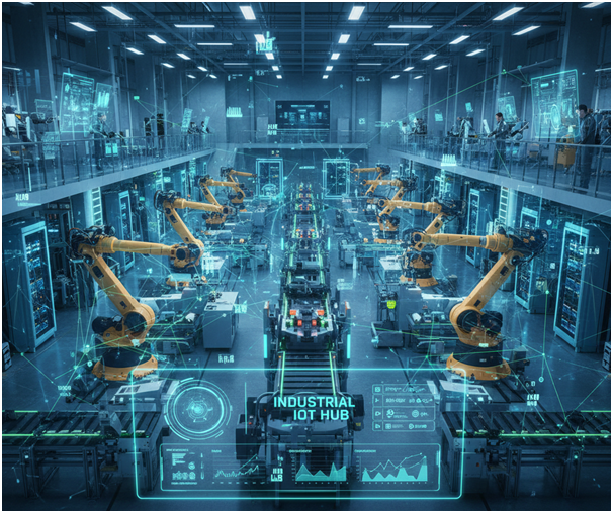
According to Growth Market Reports, the global Industrial Internet of Things (IIoT) market size reached USD 286.7 billion in 2024, reflecting robust growth driven by rapid digital transformation across industrial sectors. The market is projected to expand at a CAGR of 14.2% during the forecast period, reaching approximately USD 797.2 billion by 2033. This impressive growth trajectory is primarily fueled by the increasing adoption of automation, real-time data analytics, and intelligent connectivity within traditional industrial environments. As per our analysis, the ongoing integration of IIoT technologies is fundamentally reshaping operational efficiency, productivity, and business models across a wide range of industries, setting the stage for a transformative decade ahead.
The Industrial Internet of Things (IIoT) has emerged as a cornerstone of digital transformation in industrial sectors worldwide, reshaping how enterprises operate, monitor assets, optimize processes, and unlock new value streams. From manufacturing floors to energy grids, from logistics networks to smart utilities, IIoT technologies are revolutionizing traditional industrial paradigms enabling real-time insights, predictive analytics, and autonomous decision-making.
Key Drivers
Digital Transformation and Industry 4.0
Industry 4.0 initiatives, which emphasize interconnected systems and smart manufacturing, are major catalysts for IIoT growth. Industrial enterprises are embracing digital platforms to support factory automation, robotics integration, and real-time monitoring all powered by IIoT infrastructure.
Predictive Maintenance and Operational Efficiency
One of the most compelling use cases of IIoT is predictive maintenance using real-time sensor data and analytics to anticipate equipment failure before it occurs. This minimizes costly downtime, extends asset life, and improves operational efficiency, making predictive maintenance a dominant application in the market.
Technological Advancements – AI, Edge Computing & 5G
Emerging technologies are deeply intertwined with IIoT growth:
Artificial Intelligence (AI) and Machine Learning (ML) enable advanced analytics that turn raw data into actionable insights for optimization and anomaly detection.
Edge computing brings processing closer to data sources, reducing latency and bandwidth demand, and enabling immediate decision-making for mission-critical systems.
5G connectivity enhances real-time communication with ultra-low latency and high bandwidth, unlocking previously infeasible industrial use cases.
These innovations collectively fuel the adoption of IIoT across manufacturing, logistics, energy, and other verticals.
Challenges and Market Restraints
High Implementation Costs
Deploying comprehensive IIoT systems especially across brownfield sites often requires substantial capital investment in sensors, communication infrastructure, and integration services. Many small and medium enterprises face financial constraints that slow adoption.
Security and Privacy Concerns
Connecting critical infrastructure to networks exposes systems to cybersecurity risks. Without standardized security protocols, industrial enterprises must invest heavily in protective measures to safeguard data, networks, and operational continuity.
Integration and Interoperability Issues
Industrial environments often contain legacy systems that lack connectivity. Integrating these with modern IIoT platforms can be complex, requiring custom interfaces and middleware solutions which increases costs and implementation timelines.
Skilled Workforce Gap
IIoT requires expertise across industrial operations, IT networking, data analytics, and security a combination that is currently in short supply, creating talent gaps for adoption and maintenance.
Future Outlook
The future of the Industrial Internet of Things (IIoT) market remains highly promising, driven by accelerating digital transformation across manufacturing, energy, logistics, and infrastructure sectors. Over the next decade, IIoT adoption is expected to shift from isolated deployments to fully integrated, enterprise-wide ecosystems powered by artificial intelligence, edge computing, and advanced connectivity such as private 5G networks.
Competitive Landscape
Prominent companies operating in the market are:
- Siemens
- General Electric (GE)
- Honeywell International
- ABB Ltd.
- Rockwell Automation
- Schneider Electric
- Cisco Systems
- IBM Corporation
- Emerson Electric
- Bosch Rexroth
- Intel Corporation
- PTC Inc.
- Hitachi Ltd.
- SAP SE
- Mitsubishi Electric
Source:https://growthmarketreports.com/report/industrial-internet-of-things-market-global-industry-analysis