


Artificial intelligence may be dominating headlines, but the real competition is unfolding inside semiconductor fabrication plants. As chipmakers race to deliver processors for AI servers, advanced smartphones, electric vehicles, data centers, and next-generation communications, the equipment used to manufacture those chips is becoming a strategic asset. Lithography, deposition, etching, inspection, metrology, packaging, and testing technologies increasingly determine how quickly manufacturers can scale advanced designs while maintaining yield and controlling costs.
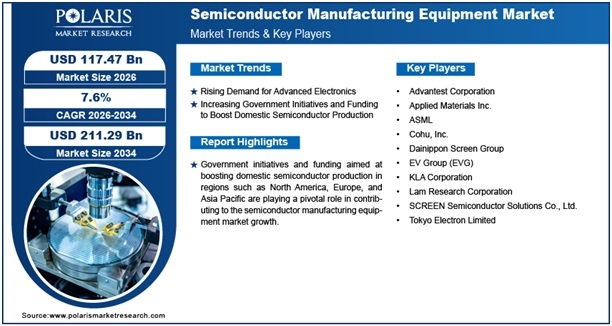
That is helping reshape the Semiconductor Manufacturing Equipment Market, which was valued at $109.33 billion in 2025 and is projected to reach $211.29 billion by 2034, expanding at a 7.6% CAGR from 2026 to 2034. The bigger story, however, is how AI, geopolitical pressures, advanced packaging, and semiconductor localization are changing what chipmakers need from equipment suppliers.
The Industry Shift Behind Semiconductor Manufacturing Equipment
The semiconductor industry is entering a period in which simply producing more chips is no longer enough. Manufacturers must produce increasingly complex architectures with tighter tolerances, higher performance, and better energy efficiency.
AI is accelerating this transition. High-performance processors require sophisticated manufacturing processes, while data-center expansion is increasing demand for advanced logic and memory. The Polaris report identifies logic as the largest product segment in 2025, reflecting demand from AI, high-performance computing, and advanced data-center applications.
At the same time, shrinking feature sizes are increasing the importance of EUV lithography, precision etching, thin-film deposition, process control, and defect inspection. Advanced packaging is becoming equally important as chipmakers explore 2.5D and 3D architectures to overcome some of the limitations of conventional scaling.
What the Market Means for Businesses
For equipment manufacturers, the opportunity extends well beyond selling individual machines. Semiconductor fabs operate within highly interconnected production environments, meaning customers increasingly value equipment that can integrate with automation, factory software, process-control systems, and predictive maintenance platforms.
This creates opportunities in both front-end and back-end manufacturing. Lithography, deposition, etching, cleaning, and wafer processing remain essential, while advanced packaging, bonding, metrology, and testing are gaining strategic importance.
There is also a major business consideration on the cost side. Semiconductor equipment requires substantial capital expenditure, and customized systems can involve long delivery and qualification cycles. For smaller manufacturers, these costs can make technology upgrades difficult. For established players, however, equipment efficiency, yield improvement, and lifecycle support can become important competitive differentiators.
Government policy is another major influence. Subsidies and incentives designed to expand domestic chip production are encouraging new fab construction across multiple regions. That creates downstream demand for everything from fabrication tools to automation, chemical-control, gas-management, inspection, and testing systems.
For more information, visit @ https://www.polarismarketresearch.com/industry-analysis/semiconductor-manufacturing-equipment-market
Regional Market Dynamics
Asia Pacific remains the center of gravity. The region held the largest market share in 2025, supported by deeply integrated semiconductor ecosystems across Taiwan, South Korea, Japan, and China. Its strength comes not simply from manufacturing capacity but from the concentration of foundries, equipment suppliers, materials companies, and supporting infrastructure.
North America, meanwhile, is positioned for the fastest growth through 2034. The CHIPS and Science Act, domestic fab construction, and investment in AI, advanced packaging, and next-generation manufacturing are strengthening regional demand for semiconductor equipment.
For suppliers, this geographic shift means opportunity is becoming more distributed—even as Asia Pacific retains its manufacturing leadership.
Competitive Landscape and Innovation
Competition is increasingly defined by specialized technological capabilities. ASML is central to advanced EUV lithography, while Applied Materials and Lam Research have strong positions in deposition and etching. KLA focuses heavily on inspection and measurement, while Advantest and Cohu participate in testing and handling technologies. Tokyo Electron, SCREEN Semiconductor Solutions, EV Group, and Dainippon Screen Group are also among the companies shaping the competitive environment.
The competitive frontier is moving toward AI-enabled metrology, defect detection, atomic layer deposition, advanced bonding, and equipment designed for heterogeneous integration. Strategic partnerships with chipmakers and materials suppliers are also becoming important because new manufacturing technologies require close collaboration during development and qualification.
What Comes Next: From Smaller Chips to Smarter Manufacturing
The next phase of the Semiconductor Manufacturing Equipment Market will be shaped by a combination of technological complexity and supply-chain resilience.
Three-dimensional integration is particularly important. The report projects 3D ICs to record the fastest growth among dimensions, supported by technologies such as through-silicon vias and hybrid bonding. Meanwhile, memory demand is benefiting from AI training, cloud computing, and data-intensive applications.
The equipment itself is also becoming smarter. AI-assisted inspection, predictive maintenance, automated process control, and data-driven yield optimization can help fabs operate expensive tools more efficiently.
The Bigger Business Picture
Semiconductor manufacturing equipment is becoming more than an industrial supply category. It is increasingly part of the strategic infrastructure supporting AI, communications, automotive technology, and digital economies.
As countries seek greater control over semiconductor supply chains and manufacturers pursue ever more complex architectures, the ability to build chips efficiently will depend heavily on the machinery behind them. The winners in the next stage may therefore be determined not only by who designs the most advanced chip, but by who can manufacture that chip at scale, with precision, yield, resilience, and speed.
Read More @ www.polarismarketresearch.com