


Market Summary
According to Research intelo, The global AI server electronic components stack market was valued at $19.2 billion in 2025 and is projected to reach $132.4 billion by 2034, registering a compound annual growth rate (CAGR) of 23.8% during the forecast period 2026-2034, driven by accelerating capital investment in large-scale AI data centers, the proliferation of GPU and custom AI accelerator clusters, and a structural shift in server power architectures toward higher wattage and more complex voltage regulation topologies.
Introduction
Artificial intelligence is no longer developing only inside algorithms and software environments. Behind every large language model, computer-vision system, recommendation engine, autonomous platform, and generative AI application is a sophisticated physical infrastructure designed to process enormous volumes of data at exceptional speed. At the center of this infrastructure is the AI server electronic components stack—a collection of processors, memory technologies, power systems, networking devices, thermal-management components, storage interfaces, and supporting electronics that collectively determine how efficiently an AI server can operate.
The AI Server Electronic Components Stack Market is therefore emerging as an important technology ecosystem rather than a conventional hardware segment. As organizations move from experimental AI projects toward production-scale deployments, demand is shifting toward components capable of supporting higher compute density, faster data movement, improved energy efficiency, and increasingly complex system architectures.
What Is the AI Server Electronic Components Stack Market?
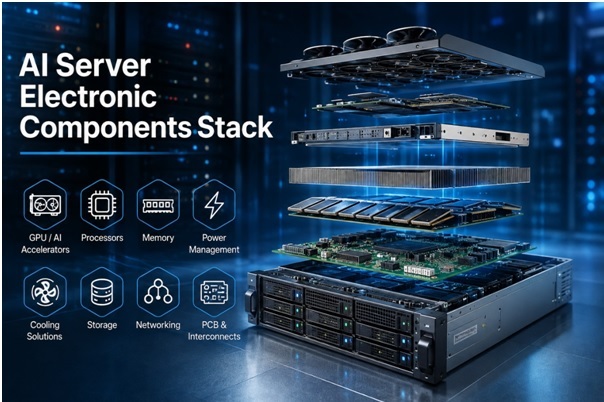
The AI Server Electronic Components Stack Market refers to the ecosystem of electronic hardware components used to build and operate servers optimized for artificial intelligence workloads. These components extend beyond the primary AI accelerator. They include CPUs, GPUs, AI accelerators, high-bandwidth memory, power-management integrated circuits, voltage regulators, high-speed interconnects, network controllers, optical and electrical connectivity, storage controllers, sensors, thermal-management electronics, and other supporting semiconductor technologies.
The key idea is simple: AI performance depends on the entire hardware stack, not on a single processor. A powerful accelerator cannot deliver its potential if memory bandwidth is inadequate, networking creates bottlenecks, power delivery is unstable, or cooling systems cannot remove the generated heat.
Why Is the AI Server Electronic Components Stack Market Growing?
The expansion of generative AI is one of the strongest forces reshaping server architecture. AI models increasingly require massive parallel computing capabilities and rapid movement of data between processors and memory. This has encouraged data-center operators and cloud providers to deploy servers with specialized accelerators and increasingly sophisticated supporting electronics.
Another major growth factor is the transition from model training to AI inference. Training requires enormous computational resources, but inference is becoming equally important as AI applications reach customer-service platforms, enterprise software, search engines, industrial systems, healthcare technologies, and edge environments.
As inference workloads become continuous and geographically distributed, businesses need servers that can deliver predictable performance while controlling energy consumption and operating costs. This creates opportunities across nearly every layer of the electronic component stack.
Which Components Are Included in an AI Server Electronic Components Stack?
AI Accelerators and Processing Units
AI accelerators represent the computational heart of modern AI servers. GPUs remain highly important because of their parallel-processing capabilities, while application-specific accelerators and other specialized processors are gaining attention for workloads where efficiency and workload optimization are priorities.
The competitive landscape is moving beyond raw processing power. Developers and data-center operators increasingly evaluate accelerator performance alongside memory capacity, software compatibility, interconnect technology, power consumption, and total cost of ownership.
High-Bandwidth Memory
Memory has become a critical component of AI infrastructure because modern AI workloads continuously move large datasets between processing units and memory systems. High-bandwidth memory technologies help reduce data-transfer limitations and allow accelerators to access information more rapidly.
As AI models become larger, memory capacity and bandwidth can become just as strategically important as processor performance. This is creating a growing requirement for advanced memory packaging and high-speed memory interfaces.
Power Management Components
AI servers can consume substantial amounts of electrical power, making power-management electronics essential. Voltage regulators, power-management ICs, power stages, controllers, and related components help deliver stable and efficient power to processors and accelerators.
Future server designs are expected to place even greater emphasis on power efficiency because electricity availability and data-center operating costs are becoming strategic considerations. Component suppliers that can improve power density without compromising reliability may therefore gain an important competitive advantage.
High-Speed Networking and Interconnects
AI workloads frequently require multiple accelerators and servers to communicate with one another. High-speed networking components and interconnect technologies enable these systems to behave more like coordinated computing platforms rather than isolated machines.
This makes network controllers, switches, transceivers, optical components, connectors, and signal-integrity technologies increasingly important within the AI server electronics ecosystem.
Storage and Data-Movement Components
AI systems require rapid access to training datasets, model parameters, checkpoints, logs, and application data. Consequently, storage controllers and high-speed storage interfaces are becoming important parts of AI server design.
The objective is not simply to increase storage capacity. The larger challenge is moving data quickly enough to prevent expensive processors from sitting idle while waiting for information.
Thermal and Monitoring Electronics
More computational power generally means more heat. AI server architectures therefore require sophisticated thermal-management solutions, including sensors, controllers, power-monitoring electronics, and hardware supporting advanced cooling architectures.
Thermal electronics increasingly play a role in maintaining reliability and performance. Monitoring temperature, voltage, current, and system behavior enables operators to identify potential problems before they become costly failures.
How Is AI Changing Traditional Server Architecture?
Traditional enterprise servers were often designed around general-purpose computing. AI servers are fundamentally different because their architecture must accommodate parallel processing, accelerated memory access, high-speed communication, and significantly greater power density.
The result is a shift from a processor-centric design philosophy toward a system-level optimization model.
In this model, the processor, memory, networking, power delivery, cooling, and software environment must work together. A component that appears superior individually may not necessarily produce the best system-level performance if it introduces communication, power, thermal, or compatibility limitations elsewhere.
What Are the Major Trends Shaping the Market?
Increasing Compute Density
Data-center operators want to perform more computation within limited physical space. This is encouraging the development of higher-performance processors and compact supporting electronics.
Greater compute density, however, increases power and thermal requirements. Therefore, component innovation is occurring simultaneously across processing, power delivery, cooling, and monitoring.
Chiplet-Based Architecture
Chiplet approaches are attracting attention because they allow complex processors and systems to be constructed from multiple specialized silicon blocks. This architecture can provide greater design flexibility and may help manufacturers optimize different portions of a system for specific functions.
For the broader component ecosystem, chiplet-based designs could increase demand for advanced packaging, high-speed interconnects, and sophisticated power-management solutions.
Optical Connectivity
As AI clusters become larger, electrical interconnects face challenges related to distance, power consumption, and signal integrity. Optical technologies can help support high-speed data movement across increasingly demanding infrastructure.
This creates opportunities for optical transceivers, photonic components, fiber connectivity, and related electronics within AI data centers.
Energy-Efficient AI Infrastructure
Energy efficiency is moving from an operational concern to a design priority. Data-center owners increasingly need to understand the amount of computation delivered for every unit of electricity consumed.
This is encouraging innovation in processors, power conversion, memory, networking, cooling, and system-level power management.
Liquid Cooling and Advanced Thermal Design
High-performance AI servers generate considerable heat, making conventional air cooling increasingly challenging for some high-density deployments. Liquid-cooling architectures are consequently becoming more significant.
This trend creates opportunities for electronic monitoring systems, thermal sensors, controllers, pumps, power electronics, and other components that support advanced cooling environments.
What Are the Key Challenges?
The market faces several structural challenges. Semiconductor manufacturing remains capital intensive, while advanced components can have complex supply chains involving multiple specialized suppliers. Any disruption affecting processors, memory, substrates, packaging materials, networking devices, or power components can influence server production.
Another challenge is rapid technological change. Component suppliers must continuously improve performance because AI workloads evolve quickly. A technology that is highly competitive today may face architectural pressure tomorrow.
Energy availability is another important consideration. The expansion of AI data centers can increase electricity demand, making energy-efficient component design increasingly important for both economics and sustainability.
What Opportunities Exist for Component Manufacturers?
The greatest opportunities may not necessarily come from producing the fastest individual component. Increasingly, value can emerge from solving system-level problems.
Manufacturers can differentiate themselves through better thermal efficiency, lower power consumption, improved reliability, higher signal integrity, advanced packaging, intelligent monitoring, and interoperability.
Component suppliers that understand the complete AI server architecture can also develop products that integrate more effectively with processors, memory, networking, and power systems. This systems-oriented approach can create stronger long-term relationships with server manufacturers and data-center operators.
How Will the AI Server Electronic Components Stack Market Evolve?
According to Research intelo,The future of the market will likely be defined by integration, efficiency, and specialization.
AI servers are expected to become increasingly heterogeneous, combining different types of processors and accelerators according to workload requirements. Memory systems will continue to evolve alongside compute architectures, while high-speed interconnects will become increasingly important as AI clusters scale.
At the same time, energy efficiency will become a central performance metric. The winning architecture will not simply be the one capable of delivering the highest theoretical computing performance. It will increasingly be the system that delivers useful AI computation efficiently, reliably, and economically.
Source:-https://researchintelo.com/report/ai-server-electronic-components-stack-market