


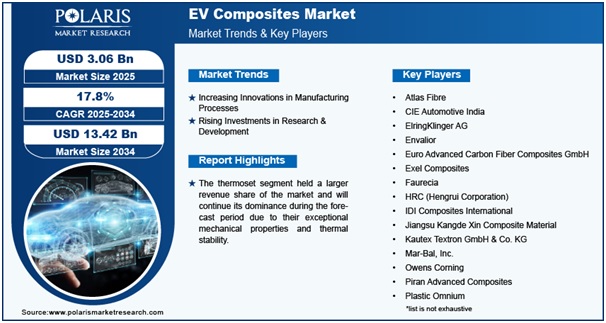
The global Chemicals & Materials industry is witnessing a significant transformation, fueled by the rapid adoption of electric vehicles (EVs) and the urgent need for lightweight, high-performance materials. At the forefront of this transition is the EV Composites Market, a high-growth segment redefining material innovation in automotive manufacturing. According to insights from Polaris Market Research, the global EV composites market was valued at USD 2.61 billion in 2024 and is projected to surge to USD 13.42 billion by 2034, expanding at a remarkable CAGR of 17.8% from 2025 to 2034.
This rapid growth underscores the increasing reliance on advanced composite materials to enhance EV efficiency, safety, and sustainability. As automotive manufacturers accelerate electrification strategies, composites are becoming indispensable in achieving next-generation vehicle performance.
Unlock Growth Potential: Why EV Composites Are the Backbone of Future Mobility
Electric vehicles demand materials that can deliver superior strength while minimizing weight. EV composites—engineered using fibers such as carbon fiber and glass fiber combined with advanced resins—offer an unmatched strength-to-weight ratio, enabling automakers to reduce vehicle mass without compromising structural integrity.
Weight reduction plays a critical role in EV performance. Lighter vehicles require less energy to operate, directly improving battery efficiency and extending driving range—two key factors influencing consumer adoption. This has positioned EV composites as a strategic material solution for OEMs striving to enhance vehicle range and overall efficiency.
Click Here to Explore How Lightweight Materials Are Driving EV Innovation and Market Expansion
The surge in EV adoption globally is the primary driver of the EV composites market. Governments across major economies are implementing stringent emission regulations and offering incentives to promote electric mobility. As a result, automakers are increasingly integrating composites into EV design, particularly in structural components such as chassis, battery enclosures, and body panels.
Additionally, advancements in composite manufacturing technologies—such as compression molding, injection molding, and resin transfer molding (RTM)—are improving scalability and cost efficiency, making these materials more accessible for mass production.
Material Innovation: Carbon Fiber Leads, Glass Fiber Expands Accessibility
Among fiber types, carbon fiber composites dominate the EV composites market due to their exceptional mechanical strength, stiffness, and lightweight properties. These attributes make carbon fiber ideal for high-performance EV components, including structural frames and battery systems.
However, glass fiber composites are gaining traction as a cost-effective alternative, particularly for non-structural and semi-structural applications. Their affordability and versatility make them suitable for broader adoption across mid-range and entry-level EV models, supporting market expansion across price-sensitive regions.
On the resin front, thermoset resins hold a dominant share due to their superior thermal stability, durability, and impact resistance—critical properties for EV applications operating under high stress and temperature conditions.
Emerging Trends: Bio-Based and Nanocomposites Shaping the Future
Sustainability is becoming a central focus in the EV composites ecosystem. Manufacturers are increasingly investing in bio-based composites derived from renewable resources, which help reduce the carbon footprint of vehicle production.
Simultaneously, the development of nanocomposites is unlocking new possibilities in material performance. By incorporating nanomaterials, these composites offer enhanced electrical conductivity, thermal resistance, and mechanical strength, making them ideal for advanced EV applications such as battery enclosures and electronic components.
These innovations are not only improving product performance but also aligning with global sustainability goals, further accelerating market adoption.
For more information, visit @ https://www.polarismarketresearch.com/industry-analysis/ev-composites-market
Application Expansion Across EV Architecture
EV composites are being extensively used across multiple vehicle applications, including interiors, exteriors, battery enclosures, and powertrain components. Among these, battery enclosures represent a rapidly growing application segment, driven by the need for lightweight yet robust materials that ensure safety and thermal management.
In addition, composites are increasingly utilized in aerodynamic components, helping reduce drag and improve vehicle efficiency. The integration of composites into EV architecture is enabling manufacturers to design vehicles that are not only lighter but also more durable and energy-efficient.
Regional Outlook: Asia-Pacific Leads the Charge
Geographically, the Asia-Pacific region dominates the EV composites market and is expected to maintain its leadership throughout the forecast period. This growth is primarily driven by strong EV adoption in countries such as China, Japan, and South Korea, supported by government policies and technological advancements.
North America is also witnessing significant growth, fueled by increasing investments in EV infrastructure, favorable regulatory frameworks, and rising consumer awareness of sustainable mobility solutions. Europe, with its stringent emission standards and aggressive electrification targets, continues to be a key market for advanced composite materials.
Competitive Landscape and Strategic Developments
The EV composites market is highly competitive, with leading players focusing on innovation, partnerships, and capacity expansion to strengthen their market position. Key companies operating in the market include Owens Corning, Teijin Limited, Toray Industries, SGL Carbon, Röchling SE & Co. KG, and Syensqo, among others.
These companies are investing heavily in research and development to create next-generation materials that meet the evolving requirements of EV manufacturers. Strategic collaborations with automotive OEMs are also enabling faster commercialization of advanced composite solutions.
Challenges and Opportunities Ahead
Despite its strong growth trajectory, the EV composites market faces challenges such as high material costs and complex manufacturing processes. Carbon fiber, in particular, remains relatively expensive, limiting its adoption in cost-sensitive segments.
However, ongoing advancements in production technologies and increasing economies of scale are expected to reduce costs over time. Additionally, the growing emphasis on sustainability and circular economy principles is creating new opportunities for recyclable and eco-friendly composite materials.
Conclusion: Driving the Future of Sustainable Mobility
The EV Composites Market is set to play a pivotal role in shaping the future of the automotive and chemicals & materials industries. As electric vehicles become the cornerstone of global transportation, the demand for lightweight, durable, and sustainable materials will continue to rise.
With rapid technological advancements, expanding application scope, and strong policy support, EV composites are poised to unlock new levels of performance and efficiency in electric mobility.
Read More @ https://www.polarismarketresearch.com