


AI-supported analyses increase transparency and line throughput
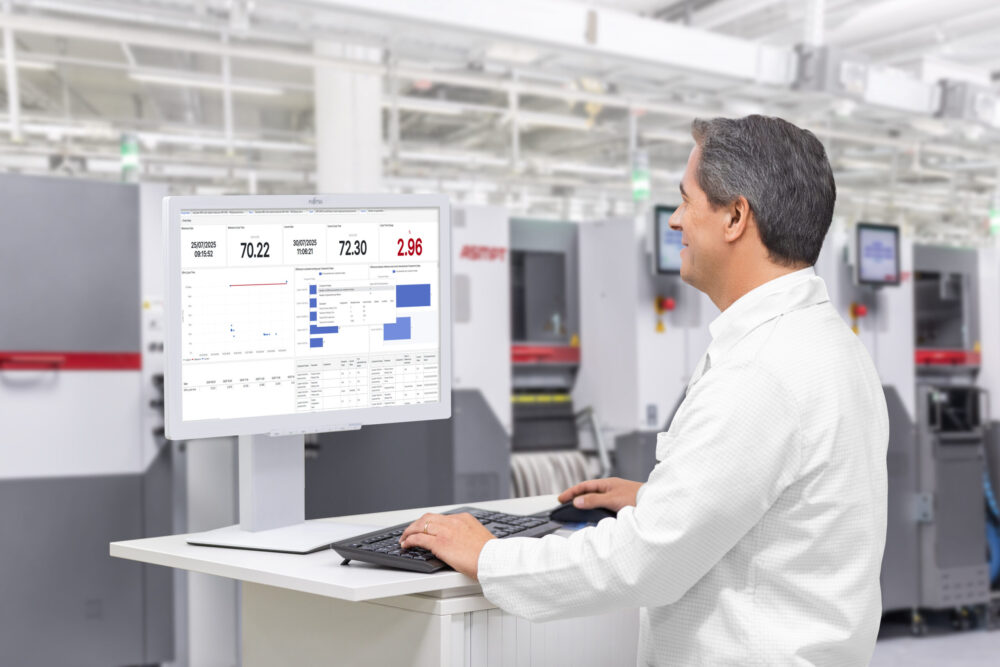
ASMPT SMT Solutions is further enhancing its SMT Analytics software solution with expanded analytics capabilities. A key new feature is Line Balance Analysis, which for the first time enables a station-spanning evaluation of time utilization across entire SMT lines. In addition, the existing use cases, Theoretical Cycle Time Comparison and Reject Analysis, have been functionally expanded.
SMT Analytics consolidates production data from multiple lines and correlates it with theoretically optimal reference values. The objective is to reliably identify bottlenecks, imbalanced line configurations and hidden optimization potential – even in complex manufacturing environments.
Advanced analysis functions for line optimization
The new Line Balance Analysis compares the actual cycle time of a product at each individual station with reference values calculated by the WORKS Programming software. Deviations and throughput-limiting process steps become immediately visible. Users can quickly identify which stations constrain line performance and how different programs affect overall line balance.
The enhanced Theoretical Cycle Time Comparison additionally reveals where programming parameters such as waiting times or acceleration settings deviate from the theoretical optimum. Since such parameters typically influence thousands of placement cycles, the resulting optimization potential is substantial.
The Reject Analysis use case has also been expanded. In addition to reject rates, evaluations can now be performed on a component cost basis, enabling a more precise assessment of economic impact. Through integration with the Factory Equipment Center, maintenance-related information, such as feeder maintenance status, cycle counters and remaining time until the next service interval, is available directly within the analysis context.
AI-supported reporting for actionable decision-making
Another significant development step is the introduction of AI-supported reporting. An integrated assistant automatically analyzes production data and provides clearly structured, prioritized recommendations for action aimed at improving performance, component efficiency and equipment availability. This allows users to derive targeted corrective measures without the need to manually interpret complex dashboards.
Furthermore, SMT Analytics will support the integration of machines from other manufacturers, provided they support the IPC-2591 Connected Factory Exchange (CFX) protocol. This enables consistent, line-level analysis and optimization across heterogeneous production environments.
“With SMT Analytics, we systematically translate our extensive process expertise into our customers’ manufacturing operations,” says Jim Leather, Director of IoT Solutions at ASMPT. “Our goal is to simplify data-driven decision-making and consistently support manufacturers on their path toward intelligent SMT production.”